

-80x69.png)
According to 2023 data, nearly one pedestrian was killed every 72 minutes in traffic crashes on American roads. This shows how dangerous roads can be for walkers and highlights the importance of pedestrian lanes.
So, we have written this article for you. After reading it, you will be able to understand what is a pedestrian lane, its dimensions, types and safety measures.
What is Pedestrian Lane?
Pedestrian lane is the space at the side of the road that is designated for pedestrians. You call it a sidewalk or side path. This side of the road is constructed to bear the load of walkers and cyclists. This is why there are layers of concrete or asphalt on pedestrian lanes. In some rural areas, you may also find pedestrian lanes made with bricks or blocks.
Pedestrian Lane Sign / Pedestrian Only Sign
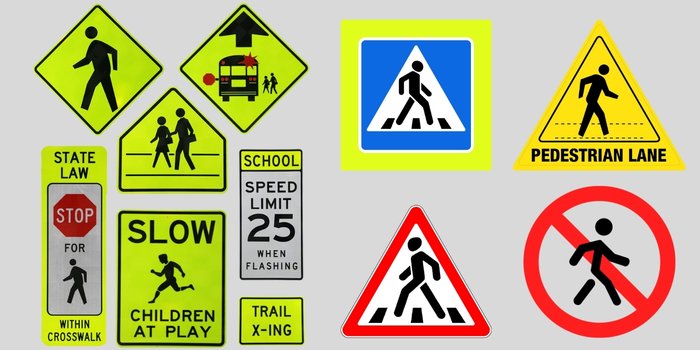
This is the type of traffic safety sign. You see it on roads with reserved side paths or at crossing spaces. Basically, they are here to tell you that this area is for pedestrians. So, you shouldn’t drive your vehicle here or try to overtake another vehicle from this space.
You see a symbol of a pedestrian on the triangle sign board. But there are possibilities you find a written text “PED Only or Pedestrian Only” with white color on the side of the road (inside white lines).
Pedestrian Lane Design
Pedestrian lanes are designed to support road walkers. At high speed roads you see a pedestrian lane at one side of the road. But in case of low traffic fall you get reserved paths at both sides of the roads.
On a straight road, they are side by side (longitudinal). When a busy intersection comes you observe crossing lines like zebra crossing lines or pedestrian crossing lines (across the road or horizontal lines). Sometimes, this lane marking moves with the turn of the road (on high traffic roads).
Pedestrian Lane Color
Mainly, white color is used to mark pedestrian lanes. But you may also see yellow or orange longitudinal lines on the sides of the road to make them more dominant. To guide road users, you might also see a walking person symbol in the lane with white color.
Sometimes, the shape of a wheel chair (blue or red) or cyclist (blue or white) is created here. In some advanced countries, illuminative colors or pavement marking tapes are also used to mark the lane. Actually, their aim is to provide directions for the walker & driver at night.
Pedestrian Lane Dimension
The dimension of the lane mainly depends on the type of the road and its users. For example, if you see a pedestrian lane near a hospital then it is reserved for wheelchair users and disabled people. Generally, the width of the lane is taken 5 to 8 ft (1.5 to 2.4 meters).
You also have a buffer zone (between white marking lines) of 0 to 4 ft (0 to 1.2 meters). You can use the buffer zone when there is more crowd on the lane. But you have to be more careful. If we talk about the length of the pedestrian lane it completely depends on the length of the road.
Types of Pedestrian Lanes
Marked Pedestrian Lane
In busy areas, you find painted lines on the edge of the lanes. These are two white or orange lines at one or both sides of the road. Actually, busy roads are common in cities or near markets where space is always an issue.
This is why paint is used to save space or warn drivers about the presence of footpath users. Furthermore, these places where long term construction is not suitable. Therefore, painted pedestrian lanes are chosen due to their easy method of application.
Raised Pedestrian Lane
Some roads have elevated sides (higher than the road surface), well these are also designed for footwalkers. These are more common at less busy roads. This height or a little elevation is to keep the driver away from you.
You often find this type of pedestrian lane near school zones, kids gardens, playgrounds or parks. At the start or end point of the lane you see curb or ramps. These ramps make it suitable for wheelchairs or baby strollers.
Pedestrian Lane Rules
As a Pedestrian
- Always use your pavement (sidewalk or pedestrian lane) when it’s available.
- At night or in poor visibility, walk away from the vehicles. Especially when traffic is heavy.
- Try to use your nearest pedestrian lane whenever possible.
- Always obey pedestrian lights or traffic signals when crossing the road.
- You look both ways before you step onto the lane.
- Avoid distraction, for instance do not use your phone or headphones while crossing.
- Give way to vehicles if your lane is not clearly marked.
As a Driver
- When you see two longitudinal lines, keep a safe space.
- Do not use this space even if there is no pedestrian on the lane.
- When you find children in the lane, slow down your speed.
- When you reach an intersection, be more careful, watch at each side of the road and follow road markings.
- Avoid parking on a pedestrian lane, it can lead to penalties in some countries.
- If your car breaks down on the lane try to leave space for walkers. And try to repair it fastly.
Pedestrian Lane Violation
Did you know illegal behaviour of pedestrians or violation of rules is the leading cause of accidents? According to a World Health Organization (WHO) report, about 1.19 million people died in road accidents in 2021. This study also reports that pedestrians made up 23% of these deaths. And their main reason was the violation of pedestrian lanes or pedestrian crossing.
These violations were made by both drivers and pedestrians. Therefore, you follow pedestrian lane rules all the time when you are on the road. As a Philippines citizen you could check out Philippine pedestrian rules for more detail.
Where To Put Pedestrian Lane?
There is not a pedestrian lane on the edges of the roads. These are reserved places that you see in some cities or towns. But always make sure that you put these markings near needed places like;
Near Schools: You must put proper markings of pedestrian lanes. because children cross the road without attention.
Busy Intersections: These lanes are placed at busy intersections to make sure pedestrians can cross safely.
Parks and Playgrounds: Pedestrian lanes are common near parks or playgrounds. The reason is that many people walk there, especially at night.
Shopping Areas: In crowded shopping streets, lanes guide pedestrians and reduce accidents. Moreover, people carry loads with them like shopping bags or equipment.
Public Transport Stops: Near bus stops or train stations, lanes can help people to cross passengers in a safe way.
Hospitals and Clinics: Pedestrian lanes are marked here because patients and visitors need safe crossing.
Safety Measures At Pedestrian Lane
If you want to make a pedestrian lane to make your roads safer then you must follow these rules.
- Pedestrian lanes should stay at the same level with the adjacent road.
- If there is a drainage line you should not tilt the level of the lane more than 2%.
- The walkway must be strong, even & safe to walk on for everyone.
- You have to draw a long line of paint to divide the pedestrian area from other vehicles. You can mark the path with double lines for extra safety.
- You must add speed bumps, to control the speed of the vehicles at busy places.
- Increase distance between the lane and vehicles with a marked buffer zone (space between two lines).
- You should provide street lights above or near the crossing to enhance pedestrian safety at night.
- Make sure to write “PED ONLY” in the lane to make the walkway exclusive for pedestrians.
- After marking the road, there is always a need for proper signage that is visible from a long distance.
- Your lane markings & sign board must be visible from every approach to the drivers.
- On busy turns, you can install bollards. This is necessary because there is more chance of being hit by a vehicle.
- You can place reflective tapes on the bollards for better night view.
Conclusion
We hope now you got the complete meaning of pedestrian lane and required safety steps. You should pay attention to markings and signs when you are on the road. Always remember, each line or color delivers a message to you.
We can provide you all types of safety products related to roads and pedestrian safety. Contact us now.
FAQs
Can You Walk on the Side of the Road?
Yes, you can walk on the side of the road if there’s no sidewalk or pedestrian lane. But always walk facing oncoming traffic and stay as close to the edge or shoulder as possible.
How to Walk In Pedestrian Lane?
You should not think that you are safe on the pedestrian lane. Actually, when you are on the road you are always at risk. Therefore, you have to carefully walk on the lane. Try to walk away from the vehicles. Use a buffer zone only in urgency when it is safe.
Pedestrian Lane Penalty Cost When You Hit Someone?
If you hit someone in a pedestrian lane, it can lead to serious consequences. You may face criminal charges, pay heavy fines, deal with civil lawsuits, lose your license, or even go to jail. For instance in UK, you get 5-10 penalty points or a fine of up to £5000.
People Also Search:
Tips For Pedestrian Safety in Wet Weather
Types of Crossings: Toucan, Pegasus, Puffin, Pelican, Zebra
What Are Bollards? – 14 Types, Design, Size and Installation


