

-80x69.png)
When you work at heights without safety, it can be scary and risky for you. One small slip can cause serious injury or lead to death too. A personal fall arrest system is an excellent approach to stop a fall in progress.
Today, we will talk about the personal fall arrest system (PFAS) and why they are important. Further, you will learn their components, functions, benefits and safety requirements.
What is Personal Fall Arrest System?
A personal fall arrest system (PFAS) is a safety mechanism. It is designed to stop workers from falling from height. You have to use it when you do your job at heights such as rooftops, utility poles, ladders, on scaffolding or elevated platforms.
The group of fall protection equipment in PFAS prevents you from hitting a lower surface. Moreover, when you work near open edges, this system acts as your last line of protection against serious injury or death.
Personal Fall Arrest System Components
The personal fall arrest system consists of three main components. Each item has an important role to keep you safe. When you use this system according to legal requirements, it can stop your fall and reduce injury.
Full Body Harness
It is the main part of PFAS. You wear it around your shoulders, chest & legs. This design protects your spine and stomach during fall. It connects you to the anchor point. Furthermore, it keeps you upright after a fall.
You should never use safety belts. Because only full body harnesses are approved for fall arrest use.
How to use a full body harness? You should choose a harness that meets ANSI and OSHA standards. So, consider features like D-rings, adjustable straps & padding.
After selection and inspection of the harness, you can put it on correctly. Then, adjust all straps for a snug fit. Always remember to connect it to a secure anchor point.
Connecting Means
This is the second important part of the personal fall arrest system. It is required to connect the harness to the anchor point. This controls how far you can fall. Further, two main types of connectors are a lanyard and a self-retracting lifeline.
Lanyard & Lanyard Requirements: A lanyard is a cord or strap that you use to connect your harness to an anchor point. You can use it when you only need to move a little when you are working.
Your free fall must be 6 feet or less. If you use a shock-absorbing lanyard, it must keep the fall force under 1800 lbs. It should not be longer than 6 feet.
- How to use Lanyard? The lanyard you are going to use must be able to handle a minimum tensile load of 5000 lbs. You can attach one end to your full-body harness. The other end connects to an anchor connector, deceleration device, shock absorber or anchor point.
- Self Retracting Lifeline: A self retracting lifeline (SRL) is a device which moves automatically with you as you work. With it, you can connect your harness to an anchor point. If you fall, it stops you quickly. SRLs also reduce fall distance (2 feet or less) and lower the force on your body. Well, it only needs a minimum tensile strength of 3000 lbs.
- Vertical Lifelines: It is a rope or cable that runs up and down. Make sure, it can hold 5000 pounds for one worker at a time.
- Horizontal lifelines: It is cable/rope which only runs side to side. They must be designed to manage at least twice the impact load.
Shock Absorber Fall Protection
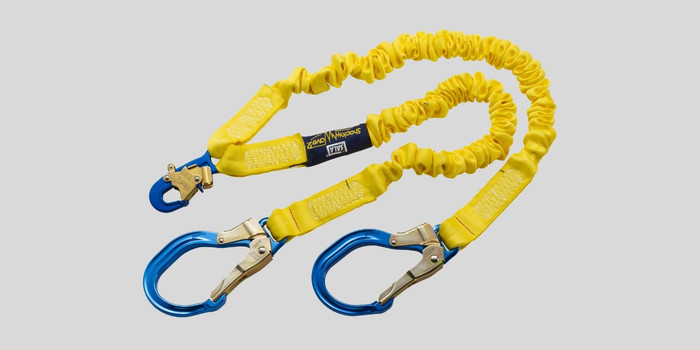
A shock absorber reduces the force(up to 50%) on your body during a fall. For example: when you fall, the shock absorber slows you down and makes the fall safer. That’s why, they are highly recommended with wire rope lifelines.
You will also find some shock absorbers that are built into the lanyard. However, most are made of webbing with special tear away stitching.
Anchorage Point
If we talk about anchorage, it is a point where you connect your harness or lifeline. So, anchorage point requirements are: it must be strong and secure to stop a fall. OSHA requires it to support at least 5000 pounds for each worker attached.
Further, the design required it to be as vertical as possible to reduce swinging. The height should be enough to keep your free fall under 6 feet.
Personal Fall Arrest System Training
PFAS training basically teaches you how to use your harness, connectors & anchor point safely. It also shows you how to stop a fall, reduce fall forces or prevent injury.
OSHA requires this training when you work at high places of 4 to 6 feet or more. In addition, this training covers inspection of your equipment and rescue procedures.
OSHA Fall Arrest System/Personal Fall Arrest System OSHA
- Connectors of PFAS must be made of strong steel and they can resist rust.
- According to OSHA standards, you should use connectors and lifelines which can hold at least 5000 pounds (22.2 kN).
- When you use a body harness, it has to keep the maximum fall force on you under 1800 pounds.
- You can wear body belts for restraint to keep you away from edges. But you cannot use them for fall arrest. Only full body harnesses are allowed to stop a fall.
- The rules say that anchor points need to be strong enough to hold at least 5000 pounds per worker. You have to design and use them under a qualified person only.
Fall Arrest System Height
It is the employer’s job to give personal fall arrest prevention systems to workers at heights. The PFAS is strictly required at height such as 6 feet in construction workplaces, 8 feet in longshoring & offshore work, 4 feet in general industry & 5 feet in shipyards.
ANSI Fall Arrest Standard
- As per ANSI rules, you need to use a full body harness which distributes fall forces across the body. It should be designed to handle weight around 130 to 310 lbs (59 to 140 kg).
- D-rings, lanyards and other connectors must meet strength and performance standards to safely arrest a fall.
- PFAS have to follow ANSI/ASSP Z359 standards plus users should be trained in proper use, inspection of this fall protection system.
Fall Arrest Australian Standard
Australian AS/NZS 1891 rules explain how to choose, use and inspect personal fall protection equipment. This includes pole straps, harnesses, lanyards, horizontal lifelines, rail systems, connectors, anchors & fall arrest devices.
- You must inspect harnesses and lanyards every 6 months. Additionally, you need to check permanent anchors and lifelines every 12 months.
- Lanyard should limit the stop force to 6 kN (about 600 kg), so your body is not hurt during a fall.
- All fall arrest parts fit and connect safely with each other. You need to make sure the snaphook gate must be strong enough to hold 6 kN
Personal Fall Arrest System Requirements
Personal fall arrest systems have specific rules that you need to follow. The section below will show you when you should use PFAS and when it is not needed.
When is a Personal Fall Arrest System Required?
OSHA requires you to use a PFAS when you work near vertical drops of 6 feet or more in construction (4 feet in general industry). It is used as a last resort when fall hazards cannot be removed.
You can also use it when guardrails or safety nets are not possible. Moreover, you have to use a PFAS when you need to do a job on roofs, scaffolds, ladders or open edges.
When is a Personal Fall Arrest System Not Required?
Generally, you do not need a personal fall arrest system when you are protected by passive fall prevention. These include guardrails and a self supported step ladder.
You also don’t need it if you use an active fall restraint system. Well, passive systems are also better because they prevent falls instead of preventing you after an accident.
Work At Height Hazards Risk Assessment
Identification of working at height hazards or dangers keeps you safe and prevents falls. Because, you can take safety precautions on time. Hence, it is important to assess the risks before you work at heights.
Bottoming Out: Bottoming out occurs when you hit the ground or something below such as equipment and materials injuring you until your fall stops.
Suspension Trauma: It is (also called orthostatic intolerance) the situation when you hang in a harness for too long. As a result, blood can pool in your legs, which reduces oxygen to your brain. This can make you feel weak or dizzy.
Pendulum Effect: There is a possibility of this danger when you swing side to side during fall. You may hit materials, equipment or part of the structure. It is also called a swing fall.
Fall Arrest vs Fall Restraint
What is a fall restraint system? The fall restraint system is designed in a way that it stops you from reaching a fall hazard. That means, you don’t fall at all. This system includes connecting devices, body wear and anchorage.
In contrast, fall arrest systems stop you after a fall starts. It keeps you from hitting the ground. We can say, restraint prevents danger, but arrest protects you during a fall. So, restraint is always safer when possible.
Fall Arrest Inspection Requirements
According to OSHA (29 CFR 1910.140 and 1926.502), you have to check your fall safety equipment before each use. Formal inspection also needed at least once a year.
OSHA harness inspection requirements say Inspectors must check harness & webbing for burns, broken fibers, sign or UV damage or chemicals. Also make sure connectors are free of cracks.
You should also confirm that shock absorbers and lanyards have no cut & broken stitching. Furthermore, check the locking mechanism of the self retracting lifeline and over length for cuts. Below are main types of inspection.
- Post fall inspection
- Perioding inspection of PFAS
- Pre use inspection
Passive Fall Protection Products
Passive fall protection uses fixed safety systems to stop falls. That means, you do not need to wear any equipment or take action. You can use the following items for fall prevention.
Guardrails: Safety guardrails are rails which are placed along edges. They stop you from falling off roofs, platforms or walkways.
Fixed barriers: Fixed barriers are strong and permanent structures. They block access to dangerous areas and protect you at all times.
Skylight covers/screens: These covers and screens installed to protect openings in roofs. They stop you from falling through fragile skylights.
Fall protection fence: You can use a safety fence to mark and block hazardous areas. They installed below the work area to catch workers in case of fall.
To Conclude
So, personal arrest system is the last line of defense against serious injuries when you are working at tall locations. We advise you to always perform a mock rescue drill and fulfill OSHA requirements before you want to start any high risk work.
Contact us now if you have inquiries about fall prevention or want to buy fall safety products for your project. We can provide you active and passive fall protection solutions.
Frequently Asked Questions
What is Clearance Distance in Fall Protection?
Fall clearance distance is actually the minimum space below you need to stop a fall safely. It prevents you from hitting the ground or objects. This distance is important for fall arrest systems. For example, a 6-foot lanyard mostly requires more than 18 feet of space below to work safely.
How Should Fall Protection Equipment Be Stored?
You should store fall prevention equipment in a clean, cool, dry and ventilated place. It’s important to keep it away from sunlight, UV rays, chemicals and fumes. Also, hang harnesses & lanyards by their D rings.
What is Collective Fall Protection?
Collective fall protection is basically a passive fall prevention. It keeps many workers safe at the same time without the need of harnesses or special training. These systems can be permanent or temporary.


