

-80x69.png)
Do you want to know correct badminton court dimensions and marking lines? If you are a court designer or player, you should understand measurements of badminton markings.
With right badminton ground dimensions, you can set up a court that allows smooth player movement. Today, I will tell you all the correct measurements of the badminton court and the right methods to mark it.
Standard Badminton Court Dimensions
The Badminton World Federation (BWF) sets the official rules and court dimensions. As a player or organizer, you have to know and follow badminton court size rules to play the game correctly.
Badminton Court Size in Meter
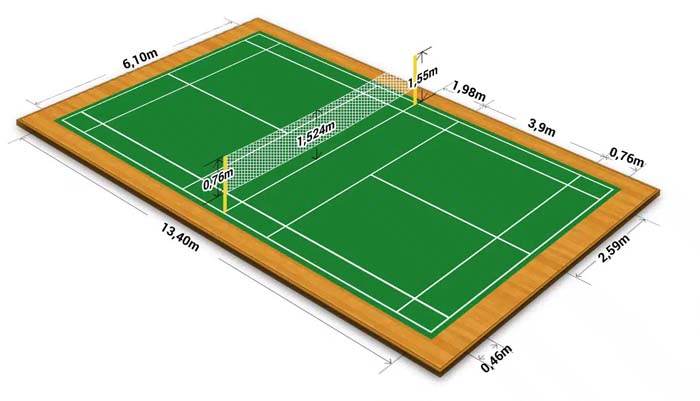
A badminton court has a rectangular shape. The length of the court is 13.4 meters. You will find a badminton ground 6.1 meters wide in professional matches.
While designing the court, you need to provide an official space of 2 meters on all sides of the playing area. However, most sports organizations suggest a safety zone of at least 2 meters if you see any walls or other obstacles nearby.
Badminton Court Size in Feet
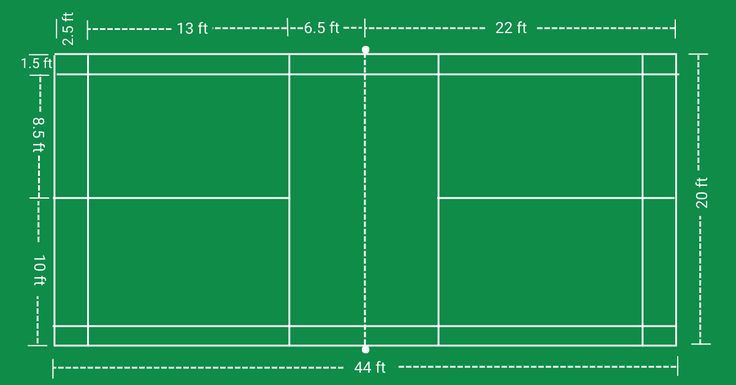
You can also measure a badminton court in feet. The standard court is 44 feet long and 20 feet wide. According to these dimensions, you should mark the court boundaries correctly.
Also, you need extra space of 2 feet around the court for safe movement. But, the ideal gap size is 6.56 feet. This space prevents accidents when you run or reach for the shuttle.
Court Area Size
The total court area size means the space you will need to design a badminton court. You may think, how big is a badminton court? The overall surface area you will require is approx. 880 square feet. In meters, this is around 81.75 square meters. This size is enough to set up the court safely for playing.
Clearance Zone
The clearance zone is the extra space around the badminton court. You need this space, so you can move safely while playing. According to official standards, You should leave at least 1 meter (about 3.3 feet) of space on each side of the court.
Behind the back boundary lines, 1.5 meters (around 5 feet) of space is required. Other than that, you need enough height above the court (30 feet is recommended).
Width of Badminton Court Line
The badminton court lines show you the boundaries. As a result, you can know where to play and serve. You have to make sure the line width is 40 mm (4 cm or 1.6 inches). This width is used for all court boundaries. So, you can see markings clearly and avoid mistakes during the game.
Badminton Court Ceiling Height
For top level tournaments such as BWF tour or Olympics, the minimum ceiling height has to be 39 feet or 12 meters. However, you can plan 29.5 feet (9 meters) height for other international badminton competitions.
Some national associations may allow you to set a low ceiling height. But, the heights below 7 meters (23 feet) are generally not suggested. You must check, the ceiling and lights should not blind you or block the shuttle.
Dimensions of Badminton Court Layout
| Dimensions | Singles Badminton Court | Doubles Badminton Court |
| Court Length | 13.41 m (14.67 yd) | 13.41 meters (14.67 yd) |
| Width of Court | 5.18 m (5.66 yd) | 6.10 m (6.67 yd) |
| Total Playing/Court Area | Around 69.5 square meters (748 square feet) | 81.8 square meters (98 square yards) |
Badminton Single Court Size
A singles court is used when only two players play the game. For example: one on each side of the net. Single courts are narrow as compared to doubles courts.
But, the length is the same for both. You will find a single court 44 feet long and 17 feet wide (nearly 13.4 meters by 5.18 meters).
Badminton Double Court Size
The doubles badminton court is designed for four players, with two on each side of the net. It has more width than a singles court. The playing area is 44 feet long and 20 feet wide (approx. 13.4 meters by 6.1 meters). You can paint side lines to mark the playing area for doubles matches.
Marking of Badminton Court & Parts of a Badminton Court
Sports facilities or court builders draw lines with marking machines on the badminton court. To paint these markings, you should follow the Badminton World Federation (BWF) or your local sports associations rules.
Net Line
You will see a net line across the middle of the court where the badminton net is located. It divides the court into two equal halves. You need to paint this line all the way across the court. Must keep each half 22 feet long (6.7 m) and 20 feet (6 m) wide. This size remains the same for both singles and doubles courts.
Short Service Line
The short service line is the line which is closest to the net on each side of the court. You can mark it 1.98 meters or 6.5 feet from the net on both sides. You should keep it 3.96 meters away from the doubles back service line. Additionally, it is marked 4.72 meters behind the baseline.
Center Line
You can draw the center line on the badminton playing area to divide the service courts into the right and left service courts. You will find this line approximately 4.64 meters (5.03 yards) long.
Sideline & Baselines
With sidelines and baselines, you can mark the outer edges of the badminton court. Basically, sidelines show you the width of the court and the baselines guide you about the length.
Baselines is also known as the singles back service line. You should paint it across the entire width of the court (20 feet / 6.1 meters). Below are two types of sidelines.
- Outer sidelines: Outlines cover the full length of the court which is 13.41 m or 44 feet. These markings are parallel to each other. You will see 5.18 meters (17 feet) distance between them. Outer sidelines are also called outer tramlines or double sidelines.
- Inner sidelines: These lines mark the width of a single badminton court. You will find 5.18 meters (17 feet) distance between these inner sidelines. You should set these markings 0.46 meters (1.5 feet) inside the outer sidelines.
Back Boundary Line
Well, the back boundary line marks the end of the court (13.4 m) at each side. It lets you know the far limit for valid shots. You can paint or mark it with a robotic painter to achieve maximum accuracy.
Long Service Line for Singles
In a single court, a long service line is used to guide how far you can serve. You will notice it close to the back boundary line. This line is painted across the court width (5.18 m or 17 ft).
Long Service Line for Doubles
You need to mark this line 2 feet 6 inches (0.72 m) in front of the back line. It is used to set the limit for how deep you can serve. A long service line makes the service area shorter, so players cannot serve too far back.
Size of Badminton Net
If we talk about the net size which is installed at court, it has a fixed dimension which you have to follow on any standard court. Plus, its height and width is the same for both singles and doubles play. The net width is 20 feet (1.55 m), which exactly matches the court width.
The net is 30 inches (0.76 meters) deep. The holes you notice in the net are around 2 to 2.5 centimeters wide. You will also find a white strip of cloth at the top of the net. This band is 2.75 inches wide. You should tie the net tightly to the posts with no gaps.
Badminton net height: The net is 1.55 meters (5 feet 1 inch) high at the posts. But, it is slightly lower at the center and where it has 1.524 meters (5 feet) height.
Badminton Post Measurement
You must use badminton posts to hold the net at both ends of the court. These posts are 1.55 meters (5 feet 1 inch) high and stand vertically. Always remember, their diameter should not be more than 10 centimeters (4 inches).
How To Mark Badminton Court?
- First of all, you need to measure the total area of the court.
- You should clearly mark the boundaries of the playing area.
- Then, you can divide the court into service areas and sections.
- Draw the lines with chalk and paint them with a good quality line painting machine for accurate markings.
- Once the court markings dry, you can install the posts and hang the net at the correct height.
Badminton Court Marking Paint
Badminton court marking paint is a special type of paint used to draw the lines on a badminton court. You should use durable and high quality paint, so players can easily see lines while they are playing the game.
Badminton Court Marking Tape
The marking tape is used to create lines on a badminton court. Because, it acts as a guide for you. You can place the tape along the line you want to paint. This will keep the paint inside the line and make the edges straight and neat. After you complete the paint, you can remove the tape to get clean and accurate lines.
Summary of Badminton Ground Measurements
Badminton courts have fixed dimensions and every line has a clear purpose. You must follow the exact BWF rules mentioned above to keep the game fair and safe. Also, check that your court surface is even and has proper lighting to prevent slips and injuries.
If you want more guidance, court setup tips or quality marking products, you can contact us anytime.
FAQs
Can You Play Badminton on a Tennis Court?
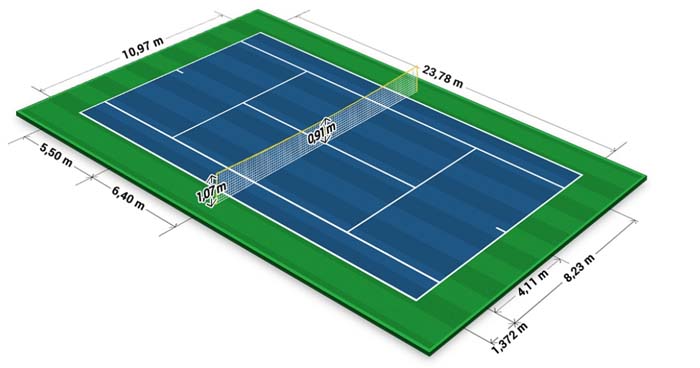
Yes, you can play badminton on a tennis court, but it is not a good option. The tennis court is much larger than a badminton court. Also, the tennis net is lower than a badminton net. It is fine for practice or casual play, but not for professional games.
What Are the Best Badminton Court Surface Material Options?
The perfect badminton court surfaces are wood, synthetic or vinyl (PVC). Wood is smooth and easy on joints, while synthetic is durable and offers good grip. Vinyl is soft, reduces injuries and is safe for indoor play.
What is the Color of the Badminton Court?
Mostly, you will find badminton courts green or blue. But ,the color can be different as long as it does not distract players. Green is common because it is easy on the eyes and was one of the first colors used for sports mats.
What is the Size of a Mini Badminton Court?
Mini badminton courts are smaller than regular courts and used for practice. Its length is usually around 8.2 meters (27 feet). The width is roughly 3.7 meters (12 feet). The total area you may require for a mini court is 32.00 square meters.
Is it Possible To Customize the Dimensions of a Badminton Court?
You are not allowed to customize the professional badminton court. Because, these courts follow strict rules set by the Badminton World Federation (BWF). However, you can design courts according to your need for home or practice use.


