

-80x69.png)
You commonly find banksmen on construction sites, warehouses, loading areas and those places where large vehicles & heavy equipment are moving. Their main job is to guide drivers and machine operators. They use special hand signals and communication tools for this purpose.
If you want to become a banksman this article is for you. You can read about responsibilities, signals, qualification and salary of the banksman.
What is a Banksman?
A banksman is a person who assists the drivers of heavy vehicles. Because it is not easy to turn or reverse a heavy vehicle on a worksite. First, the banksman stands in a spot where both the vehicle and work area stay in full view.
As a driver, you receive clear hand signals that guide the vehicle through tight gaps & around obstacles. Every move follows standard site signals. They also inform workers and pedestrians about the danger.
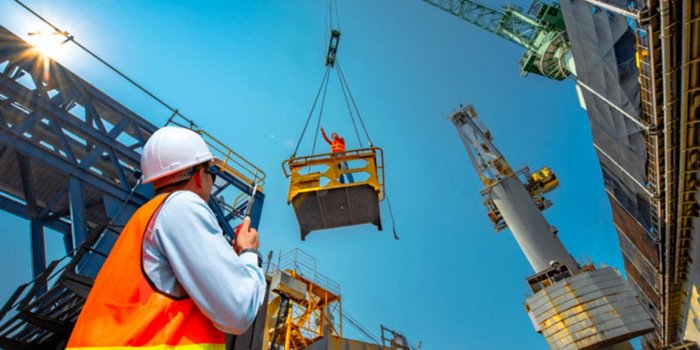
Banksman Roles and Responsibilities
What does a banksman do? A Banksman’s work is not only limited to vehicles. There are following things which a banksman has to do.
Guide Drivers
A banksman guides drivers and machine operators when they need support on site. They stand in a safe place. From there, they can see the vehicle clearly. The driver must also see the banksman at all times. Both must agree on one clear rule. If the driver loses sight of the banksman, they stop the vehicle at once.
Control Safety Standards
As a banksman, you should also make sure all safety rules on your site stay in place. You should know what safety steps the duty holder sets to reduce danger in the work area.
You have to understand the site layout where vehicles move and pedestrians walk. You should stay alert to obstacles, blind spots plus speed limits.
Signs and Signals
Well, the Health and Safety Regulations 1996 explain the standard hand and voice signals that most banksmen use. You should follow them. But if needed, you can choose a different signal system.
But both the banksman and driver must agree on it first. In some cases, voice signals work better than hand signs. This often happens when very large vehicles or heavy machines take part in the task.
Risk Assessment
A banksman uses their knowledge of the risk assessment to decide if a task is safe to start or not. They look at the area. They check for danger. If something feels unsafe, they stop the work. Then they report the problem to the right person.
Training
You must follow the training which is given by the higher authorities. The driver must do the same. You both need proper preparation before any vehicle move starts. When both of you follow the same safety system, there will be no confusion. This creates coordination during the manoeuvre.
What is a Banksman Slinger?
Slinger banksman is a specific types of banksman. A slinger is a person who guides only a crane driver in lifting operations. As you know, when you sit in the cab of the crane, the view becomes limited for you. You are not able to see around the vehicle. At that time, slingers assist you. They direct you from the ground.
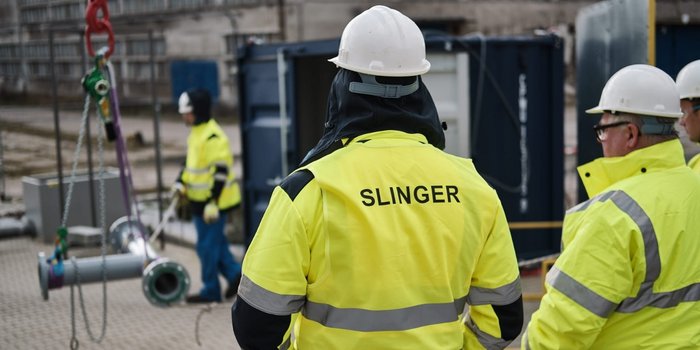
Slinger Banksman Signals
They use clear and standard hand signals. This makes sure the load lifts, moves & sets down in a safe way. Like a banksman, a slinger must understand all hazards on site. They know the risks linked to lifting work. It is their duty to spot danger before the lift starts. They reduce risk to protect your team and your equipment.
Banksman Signals
Vehicle banksman signals vary according to the project need; they can be verbal or gesture. As a banksman you have to remember these common signals to create a safe environment.
Banksman Hand Signals
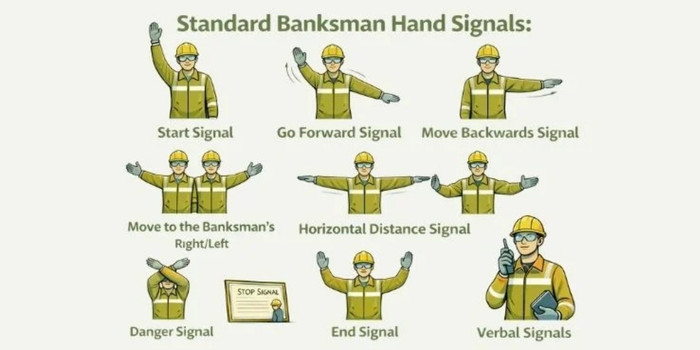
Start Signal: You use this signal to alert the driver. It tells them the vehicle will move now. For this you have to stand straight and extend both arms out at shoulder level. Make sure your palms are facing forward.
Stop Signal: This sign is used when the vehicle needs to stop calmly. Simply, no emergency action is required. Raise your right hand above your head. In this case, your palm should also face forward.
Danger Signal: If you raise both arms above your head. This means there is an immediate risk. The driver must stop at the spot. Because this sign represents serious danger ahead.
Move Forward Signal: You give this signal when the vehicle needs to go ahead. You should bend both arms at the elbows. Your palms should be toward you. Furthermore, pull your forearms slowly toward your chest. Now, repeat the motion in a calm way. This will tell the driver to select forward gear and move ahead.
Move to Your Left: If you want to guide the driver to the left side, extend your left arm straight at shoulder height. Keep your palm in the downward direction. Bend your elbow and bring your hand toward your chest. After this, extend it back out.
Move Backward Signal: You use this signal when the vehicle needs to reverse. In the same way, bend both arms at the elbows and your palms down. But now you should push your forearms away from your body slowly. This is the time when reverse gear is required.
Horizontal Distance: This signal is used to show space or gap. You can hold both hands in front of your body. At this time your palms must be toward each other. You have to leave space between your hands. If the space is less, bring your hands closer. Contrarily, move them apart to show more space.
Raise the Load: When you want to say lift the weight. You can point your right arm in an upward position. Then, make a circle with your fingers.
Lower The Load: If you want to say, lower the weight then point the right arm downward. And then slowly make a circle.
End of Operation Signal: This shows the task is complete. You should clasp both hands together in front of your chest. The driver will know the manoeuvre has finished.
Emergency Stop Signal: You should use this signal in a serious and critical situation. It means all movement must stop at once. You need to stand where the driver can see you clearly. Raise both arms above your head and wave them strongly. This is a universal emergency sign. Every driver must stop immediately.
Banksman Radio or Verbal Signals
If there is a large construction site with many blind spots, then radio communication is preferred. The very first step of this process is to check the connection. For this you have to say “Radio Check” and the operator will answer “Clear & Loud” in case of a sharp voice.
| Verbal Signal | Meaning |
| Start | This voice tells driver a safe start command |
| Raise | Means you can now uplift the load |
| Lower | You can safely put down the weight |
| Danger | It shows that there is something fishy you should stop the operation and wait for the next signal |
| Move Forward | This sharp sound means you can move further on the existing path |
| Move Backward | It is used when a banksman find a danger ahead or you need to bring something back |
| Fastly / Quickly | You need to speed up the work you are doing like lifting something or unloading goods |
| End | This voice clearly says to stop the operation |
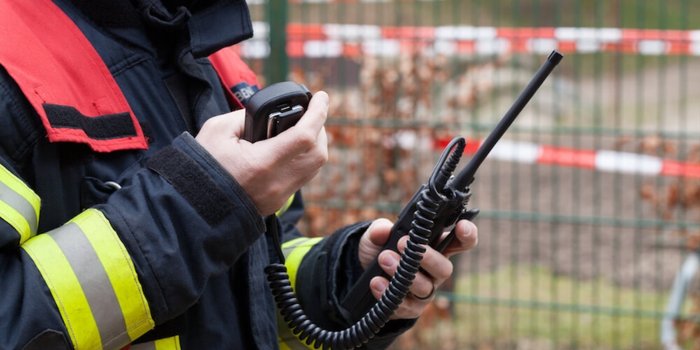
Safety Equipment Used by Banksman
Equipment Worn By Banksman
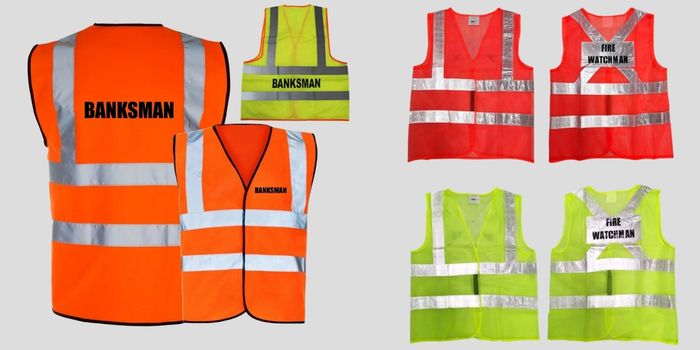
Banksman Vest: You should wear a high-visibility vest. Because it makes you easy to spot from a distance. So, operators can easily notice you, even in low light.
Safety Helmet: As a banksman, you can face head injury. Therefore, you must wear a safety helmet. Mostly, “Banksman” is written on the helmet.
Protective Goggles: Safety goggles are needed to shield your eyes. They protect from dust, debris & flying particles.
Safety Boots: The ground of any worksite is full of sharp objects. Hence you can wear strong safety boots. Its thick soles stop nails or metal from piercing your feet.
Equipment Used For Communication
Signal Flags: Well, red and green colored flags are used by banksman. These flags are used in bad weather conditions. For example, in fog, drivers can’t see gestures or hand signals clearly. This thing can cause confusion. The red flag shows there is danger. Green color means you can carry on the operation.
Whistle: This is used by banksman if the operator faces any problem to see visual signs. This sharp sound of a whistle stops the driver and command to wait for the safe sign of the banksman.
Radio: Radios allow direct voice contact. This is the most convenient way to make connections between drivers and banksman. You receive clear instructions in real time. This tool works best on large sites.
Signaling Paddles: Banksmen use STOP/GO paddles to control vehicle movement. The STOP side tells you to wait. On the other hand, the GO side tells you to move ahead carefully.
Warning Signs: Banksmen are responsible to make the site safe for everyone. Therefore, you should make sure to place warning signs, barriers, traffic cones and warning tapes if required.
Difference Between Banksman and Rigger
Rigger and banksman both work on construction sites or at mining sites. But they both perform different tasks.
| Banksman | Rigger |
| A banksman is responsible for the safe movement of heavy vehicles. They also direct operators about lifting operations | The duty of rigger is to attach or secure the load to cranes or any other lifting tool |
| The main skills include main signal methods and safety procedures | Rigger must have knowledge about load dynamics, right rigging equipment, proper knots and sling methods |
| The movement of the vehicle is the main concern of the person | Their main focus remains on load safety |
| Uses standard hand signals to direct drivers | Selects the correct slings, chains & lifting gear |
Difference Between Traffic Marshall and Banksman
| Traffic Marshal | Banksman |
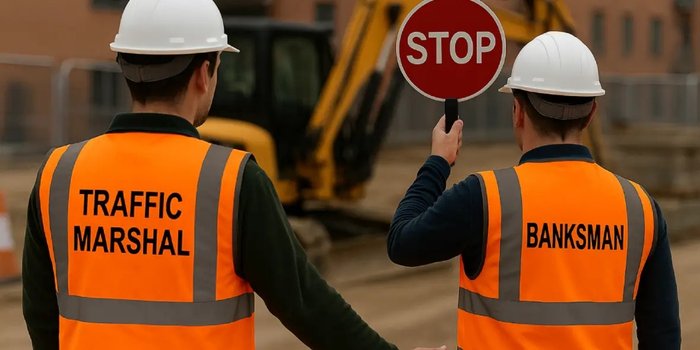
| Traffic marshals manages overall site traffic and pedestrian movement | Banksman guides heavy vehicles when driver visibility is limited |
| Main working areas are construction sites, warehouses plus event venues | Works at loading bays, transport yards and working sites |
| Reduces congestion and confusion in busy zones | Prevents collision during vehicle movement |
Banksman and Signalman
Banksmen and signalmen are trained safety professionals on site. They direct vehicle and crane movement, especially in restricted or high-risk areas where visibility is poor. Their role is vital because clear guidance prevents serious accidents.
People often use both titles in the same way, but there is a small difference. A banksman mainly controls traffic and guides reversing vehicles. A signalman, also known as a slinger, focuses on lifting tasks. And gives standard signals to crane operators during load movement.
Banksman Risk Assessment
A proper risk assessment keeps your site safe. Before any task starts, you must review the work area, equipment plus possible hazards.
Lifting Operation: Before a lift, you check the load weight and stability. You confirm the correct lifting gear is in use. Slings and chains must match the load capacity. You should also review ground conditions. Because soft or uneven surfaces can affect the stability of a crane. Hence, clear communication is essential.
Moving Vehicle: Vehicle movement creates blind spots and collision risk. That’s why before movement, you must inspect the route. You should remove obstacles and confirm clear space. The banksman must stay where the driver can see them clearly. During the operation, constant eye contact is important. If eye contact breaks, movement must stop.
Banksman Training
You cannot step into this role without proper training. First, you learn about traffic and pedestrian routes. After that you understand speed limits, loading zones and site driving rules. You also study special site conditions like overhead cables, pipes & restricted access.
Training covers the types of vehicles and mobile plants used on site. You learn how visibility aids work, such as mirrors or reversing alarms. You also understand when and how to report hazards or accidents in the language of signs or signals. Usually, training includes classroom instruction plus supervision by an experienced banksman. You work under guidance until you show full competence.
Banksman Qualification
There is no single official qualification that makes you a banksman. Actually, courses like college programs, T-Levels or a relevant CSCS card can support your career. But these alone do not make you fully qualified. Basically, you need the right skills and experience. So, when you understand site risks and vehicle movement, you become suitable for the role.
Banksman Salary
Salary of a banksman can vary according to your local authorities and the construction manager. But if we talk about the salary rates of a banksman in the UK, we have listed them in the table.
| City | Hourly Rates | Weekly Salary | Monthly Salary |
| Oxford | £18.74 | £749 | £3245 |
| Milton Keynes | £17.70 | £708 | £3065 |
| Edinburgh | £17.69 | £707 | £3063 |
| Bristol | £17.05 | £682 | £2953 |
| London | £16.86 | £674 | £2920 |
| Birmingham | £16.59 | £663 | £2873 |
| Glasgow | £16.46 | £658 | £2850 |
| Leeds | £16.19 | £647 | £2804 |
| Sheffield | £17.01 | £680 | £2946 |
Banksman Certificate
What is a banksman ticket? The banksman ticket is a certificate that shows that this person is fully trained. Furthermore, it indicates banksman can direct the heavy vehicles and machinery in any construction site.
You will carry this ticket or certificate in your bag. In case of any visit of higher authority, you have to show them you can do this work. If you do not have the ticket, then the manager and you can face difficulty. Moreover, in case of any accident this condition can get more severe.
What is a Banksman in Construction?
A banksman in construction is a trained individual who is responsible for the safe movement of heavy vehicles and machinery in construction. Actually this is done to avoid any confusion. In construction, the banksman also has knowledge about the hazardous areas. In addition, you must know about how to manage traffic for less congestion. In certain conditions, you should clear the path for pedestrians as well.
FAQs
Can a Banksman Stop Traffic?
The banksman have no legal authority to stop traffic on public highways but they can request drivers to stop for vehicle safe entry or exit.
Is a Banksman a Legal Requirement?
In some industries, like railways & construction, a banksman is a legal requirement. Basically, this is done to fully eliminate risks when the construction site includes vehicle operations.
Why is a Banksman Called a Banksman?
In 1825, a banksman was the person who stood at the “bank,” to unhook loads. So, the man who worked at that position became known as the banksman.
To Sum Up
As you are aware now, it is not easy to reverse big vehicles on large blind spots. Workers may face crash injuries or run over accidents. Since 2020, Occupational Safety and Health Administration reported 22 dump truck accidents on construction sites. Therefore, you should always hire flaggers, riggers, slingers and banksman to make your site safe.


