


As we all know, hundreds of accidents occur on bridges or roads because of our negligence. To avoid these crashes, authorities place signs before reaching the hazard so that we understand them and show reaction without delay.
But most people don’t know the meanings of bridge signage, therefore they face difficulty in proper response. For your help, we have posted this article. Today we discuss bridge signs, their explanation, design and what you should do when you see them.
Most Common Bridge Signs You Should Know
Bridge road signs warn you about bridges ahead, which may indicate narrow width, low clearance, road changes and moveable structure. Below are some bridge signs which you will see in your daily driving experience.
1. Narrow Bridge Sign
This sign tells you that the upcoming overpass is narrower than the road on which you drive. In America, it is a diamond-shaped sign with a yellow background, black border, letters or symbols. You will see two lines that pinch inward and represent the tight passage. Some versions also have words in black color such as NARROW BRIDGE.
But in UK, it shows you a triangle with white background and a red border that has two parallel lines curving inward in black color. If you notice them, you should slow your car, stay in your line and look for oncoming vehicles passing the center line.
2. Hump Bridge Sign
Hump bridge sign alerts you approaching a bridge which has raised curve center. It can reduce your visibility and cause the loss of vehicle control if you drive too fast. You will mostly see them in triangles that have white background, red border and the symbol of a hump backed bridge. But you can also observe them in a yellow diamond shape with the same symbol.
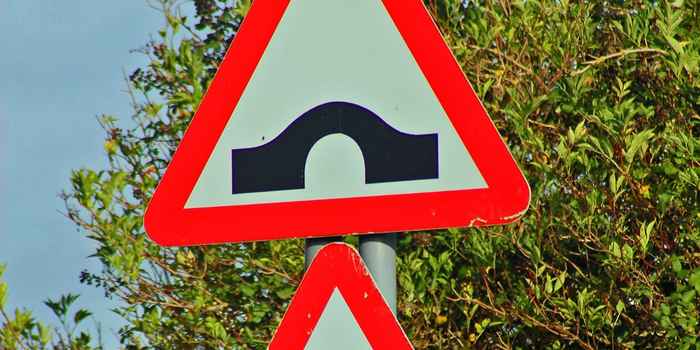
After recognizing it, you must slow down or stop for a minute to analyze cars coming from the other side. You cannot see them properly because the steep rise over bridges hides the traffic. Moreover, you should sound horns to signal others that you are coming.
3. One-Lane Bridge Sign
One lane bridge sign warns you about ahead of the road which allows only one side of traffic at a time. This yellow diamond sign also tells you that you are coming to a one lane bridge. A white circle with a red border that has a black and small red arrow indicates that you must give way to oncoming vehicles.

Whereas, a blue rectangle sign with big white and small red arrows informs you the right of way. It means you can go first but you still check that the bridge is clear.
4. Low Bridge Sign or Bridge Height Signs
These signs show the exact height limit from the surface of the road to the overpass. Low clearance sign alerts you that space is not sufficient for certain cars. You will find them in yellow diamonds or rectangles in USA which give warning to you. While it will appear in red and white circles or triangles in Europe or UK.
You should not try to pass it if your vehicle height is taller than the mentioned height. You must take another route to avoid a crash. The common standard height for big trucks is 14 or 14 feet 6 inches and for normal buses is 12 feet 6 inches or 13 feet. In addition, the height almost 10 ft to 11 ft allow cars to pass only.
5. Bridge Weight Limit Signs
Bridge weight limit indicates maximum weight of your vehicle or axle load which you can carry out when you cross the bridge. It will display you in a vertical rectangle or in a square sign which has white background, black border and text. The weight limit mentioned on it may range from 10 tons to 25+ tons.

Authorities place them near the entrance so that you can see them before crossing. In case you observe the sign, you check that your vehicle weight fulfills the requirements or not. Otherwise you should choose a different route.
6. Bridge Closed Sign
This warning signage is for drivers and pedestrians about the road ahead which is blocked & unavailable for passing. The cause can be emergencies, accidents, natural disasters, construction or repair. You do not try to cross the barrier in fact you need to look for the sign. The horizontal rectangle sign has black and bold capital letters such as BRIDGE CLOSED or BRIDGE OUT.

Furthermore, it has black boundary and reflective white base. You will also observe in yellow and orange diamond shape with the same words. It guides you to choose an alternate way or check the official transit pages to find when the bridge will reopen.
7. Draw Bridge Ahead or Swing Bridge Sign
A draw bridge ahead signage means you are approaching a moveable bridge which can open to allow the boats to pass. You can also call it a swing bridge sign because both have same function.
It will show you in the triangle with a red margin and white back color in Europe. You can also note these signs in yellow diamond shape in the US with “DRAW BRIDGE AHEAD” words. In addition both signs have the same icon which is black raised bridge above the water that displays you in the center.

If you see this sign, reduce your car speed and watch the traffic light, gates and barriers. If a yellow or red light is on, you should be ready and stop to see if the overpass is already open or available for boats. You have to wait until the light turns green and gates are open again.
8. Bridge Ices Before Road Sign
This sign warns you regarding an upcoming overpass which becomes slippery with ice more than a normal highway or road. Another cause for it can be rain, winter, snow and winter season. It is because roads get heat from earth but air above and below the bridge takes the heat from overpasses and helps in cooling it further.
You will see these signs mostly in diamond shape with yellow background, black edges and “BRIDGE ICES BEFORE ROAD” text in black and bold color.

Therefore, you should decrease the speed when you reach the bridge. You have to drive straight, maintain distance from other vehicles, avoid sharp brakes and sudden lane change. Furthermore, if you feel you are slipping, you can remove your foot from the gas pedal. Hold the steering wheel strongly until you get control of your vehicle again.
9. Low Water Bridge Sign
The low water bridge sign alerts you to the road ahead which is dipping into shallow water. In fact it can be prone to flooding and submerged during heavy rain. When storm and flood water cover the crossing, the edge of bridges become invisible. Then it also leaves behind mud, slit, dirt and debris. Which reduces the tire traction and increase risk of sliding into deep water.

If we talk about its sign, then it also has a diamond shape with black border and yellow base. A bold and black text Low Water Crossing will appear in the middle of sign. In case you find this sign you should slow down your vehicle or stop, turn around and take another way. Because a little water on the surface becomes risky for you.
10. Weak Bridge Sign
Purpose of these signs is the next structure cannot support heavy loads safely. Reason for placing the weight limit sign is the bridge is old, weak and structural damage such as cracks.
It is a yellow diamond-shaped sign that displays the maximum gross weight limit (MGW) in tons like 3 or 7.5 tons. It means if your vehicle weight is higher than the mentioned weight then you are prohibited from crossing this pavement.

Sometimes you see subplates on which write “except empty vehicles”. These signs permit entry to those cars which have no load or very low burden.
Main difference between weight limit and weak bridge sign is weight limit is a regulatory sign which is a very strict traffic law. If you violate this sign, you have to pay a fine for it. Whereas, a weak bridge sign is a warning sign which tells you upcoming pavement is weak, you must slow down your speed and look for weight restrictions. Otherwise, you are responsible for your loss.
11. Railway Bridge Sign
A railway bridge sign is warning signage which tells you about structural details, route codes and safety limits for drivers and trains. These are rectangular metal plates attached directly to the overpass which point to bridge number and route code. They also inform you that walking and climbing are not allowed on the railway bridge.

For further safety, these signs include height clearance limits, maximum weight limits, or load capacities. So, you need to be very careful or attentive, check all the guides and then take any action.
Related: Height Restriction: Types, Sign and Regulations Explained
MUTCD Code For Bridge Signs
If you are a supplier/retailer of traffic signs or a contractor, we recommend that you take care of Government compliance as well. Following is a table helps you to clearly understand required code of MUTCD for bridge signage.
| Bridge Sign Name | Purpose | MUTCD Code |
| Narrow Bridge Sign | Upcoming bridge has less width than approach roadway | W5-2 |
| Hump Bridge Sign | Tells you about a sudden and sharp bump in the road over structure | W8-1 or W17-1 |
| One Lane Bridge Sign | Car from one direction can pass and other side wait | W5-3 |
| Bridge Height Sign (Low Clearance) | Display the maximum vertical clearance height to prevent vehicle from collision | W12-2 |
| Bridge Weight Limit Sign | Restrict heavy or oversized car which exceed the specified load limit and axle weight | R12-1 |
| Bridge Closed Sign | Prohibit the traffic to enter into closed bridge ahead | R11-2 or R11-3b |
| Bridge Ices Before Road Sign | Bridges freeze faster during cold weather conditions than normal roads | W8-13 |
| Draw Bridge Sign or Swing Bridge Sign | The draw bridge warns the driver that it lifts vertically and the swing bridge turns sideways which allow the boat to pass. | W3-6 |
| Low Water Bridge Sign | Low pavement where water quickly rise up and covers the road | W8-18 |
| Weak Bridge Sign | Indicate weak structural load capacity and paired with weight restriction | R12-1 or R12-5 |
| Railway Bridge Sign | It shows the bridge identification, safe space for trains and bridges used by trains and cars. | W10-1 |
To Summarize
In the end, we will advise you that you must stay very alert and pay close attention to these signs during your drive. However, if you belong to road safety department and looking for customized traffic signs. You can contact us.
Our manufacturing team has more than 18 years of experience. We provide the best quality material signage, which is certified according to all international standards.
FAQ
How Far Before a Bridge is a Warning Sign Placed?
Bridge warning signs must be placed 100 to 500 feet or 30 to 150 meters before the overpass or hazard. It is also based on the speed limit of the road and standard guidelines such as MUTCD.
What is the Lifespan of Bridge Signs and Symbols?
The lifespan of bridge signs is almost 7 to 10 years which also depend on the material quality and weather conditions.
Why Do Long or Major Bridges Have Multiple Signs?
Long bridges such as the Golden Gate Bridge and bay bridges have many signs to keep the driver aware or update like speed limit and lane changes. They also guide you clearly to stay focused, take immediate action and different local information such as parks or attractions on long distances.


