

-80x69.png)
Today, we will discuss compression molding, its types, materials and the equipment used. I have also explained the complete process and applications in different industries.
Further, you will know which products you can make with this method and how they are used in road safety and consumer goods.
What is Compression Molding? Compression Molding Technique
Compression molding is a manufacturing process which uses heat and pressure to shape materials. With this technique, you can shape various materials such as composites, rubber, thermoset plastics or polymers.
The finished products are strong and durable, which make compression molding useful for many industries. It also reduces waste and provides a cost-effective solution.
Compression Molding Examples
You can use compression molding to make many strong products. Common examples include car body panels, engine parts, electrical housings and industrial equipment parts. This process is ideal for items that need precise shapes and high strength.
Compression Molding Equipment
There are specific machines and tools used in compression molding to shape different items.
Shop air: This part equipment is used to operate pneumatic tools and assist in controlling the press. You can also clean contamination from different components of the molding machine.
Cutting tools: Cutting tools are used to trim excess material from molded parts. So, you can get a clean and exact shape.
Large tonnage press: A large tonnage press applies high pressure to the mold. Mostly, this is in the range of 150 tons to 2500 tons.
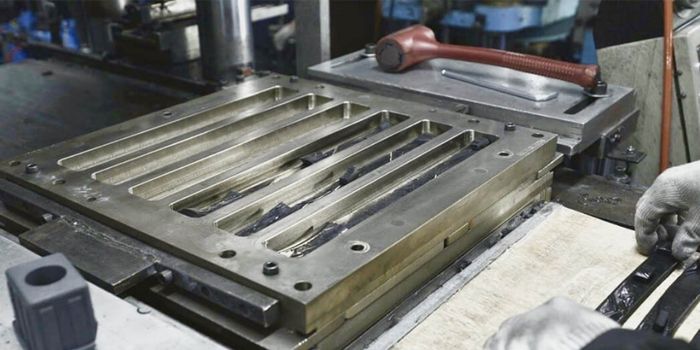
Heated mold: The mold has an upper and lower part with an inner cavity. With it, you can control how the material flows when it melts and reshapes into the final product.
Heating chamber (or oven): You can use this tool to preheat the raw material. This step makes the material soft and ready for molding.
Heating lines: These are cylindrical electrical and long resistors which serve as the main heating elements.
What is Compression Molding Process?
How does compression molding work? The compression molding process is a detailed and accurate method. You have to follow the below steps carefully for a high quality finished product.
Prepare Raw Material
First of all you need to prepare material for compression molding. Mainly, it involves cleaning, cutting & preheating the raw material. This way, you can make sure the all material is the right size for the mold & free from contamination.
You can also add curing agents (Benzoyl peroxide/Dimethyl stannane). These additives will improve bonding during the curing process.
Mold Setup and Preparation
Now, you have to create a mold to accurately shape the material. The mold you choose must maintain original properties of materials and surface finish. For mold, you can use steel alloys or aluminium. Moreover, 3D printing, die casting and CNC machining is used to prepare compression molds.
- 3D printing is ideal for rapid prototyping. You should use it to make molds with unusual designs.
- CNC machining is perfect to design precise & durable molds.
- Die casting works well for complex shapes quickly and cost effectively.
Load Material into Mold
After the preparation of mold, you can put the pre-measured material into it. Well, you can perform this step manually or with an automatic system with the use of a load hopper or conveyor.
You should keep in mind that uniform placement of material into mold is important. Because it allows the material to flow smoothly and fill the entire mold cavity during compression.
Compression and Shaping Process (Molding)
The compression molding machine has two mold halves. The machine moves these halves together. At the same time, the press plates apply the proper amount of pressure to compress the material.
As the mold closes, the material inside flows to fill the mold completely. Any extra material pushed out as flash (excess material). The platens may or may not be heated, it depends on the machine.
Cure and Harden
In the curing step, the compressed material converts into a solid final product. It also reduces the temperature of chemicals used to make the product hard. During this process, the material goes through a chemical reaction.
It changes material properties from flexible & soft to hard and rigid. If you use curing agents or catalysts, they start this reaction quickly. As a result, the material turns into a strong and durable product. You can use two types of methods for curing.
- Addition Type: It uses a platinum catalyst to cure the material.
- Condensation Type: Uses a tin catalyst to cure the material.
Controlled Cooling
After the curing process, you need to cool the molded part before you remove it from the mold. The mold temperature slowly decreases. However, you can cool it naturally or use air, water or other cooling approaches to speed up the process.
With passive cooling techniques, you can minimize the time needed for cooling. It will also make the mold ready for the next cycle in a fast way. Well, proper cooling prevents cracks and other defects in the final product.
Mold Separation and Part Ejection
Now, you can remove the finished parts from the mold. This process is called ejection. This can be done automatically or manually. Manual ejection is common in small scale applications. Automatic ejection performed by plunger or suction system to push the part out.
Moreover, simple molds may open with control arms attached to the mold halves. For complex molds, an ejector system with pins/plates pushes the part out. To make removal easier, you should apply a release agent or coating to the mold. Parts with holes, grooves or threads may be difficult to eject, so you need to handle them carefully.
Trimming and Surface Finishing
This is the final step of compression molding. After removal of parts from the mold, you can refine them as your desired shape, size and appearance requirements.
Trimming removes excess material or flash mostly by hand. You can also use CNC machines for trimming. Moreover, finishing methods such as sanding, polishing plus powder coating improve the look and overall quality of the molded parts.
Compression Molding Materials
Manufacturers can use these materials in their factory for producing compression mold products.
| Material | Category | Main Features | Common Uses |
| Urea Formaldehyde (UF) | Thermoset | Color retention, smooth finish + electrically insulator | Decorative panels, wall plates or light switches |
| Polyester (SMC/BMC) | Thermoset | Dimensionally stable, affordable plus glass fiber reinforced | Electrical housings plus automotive panels |
| Diallyl Phthalate (DAP) | Thermoset | Arc resistant, electrically insulating and low shrinkage | Circuit board parts and electrical connectors |
| Rubber/Silicone Rubber | Elastomer | Weatherproof and flexible/high elasticity | Heat resistant parts & seals/gaskets |
| Polyurethane (PU) | Elastomer | Can absorb shocks, has elasticity and abrasion resistant | Suspension parts & grommets |
| HDPE | Thermoplastic | It is tough and can block moisture & impact | Simple molded components |
| PTFE (Teflon) | Thermoplastic | Heat tolerant, protection from chemical and non stick | Sliding parts plus insulators |
| Polyamide-Imide (PAI) | High Performance | Able to handle wear extreme heat | Thrust washers, pumps & aerospace components |
| PEEK | High Performance | Biocompatible, chemical, heat resistant plus strong | Aerospace bushings and medical implants |
| PPS | High Performance | Flame retardant & heat stable | Electronics and automotive under the hood parts |
| Phenolic Resin (PF) | Thermoset | Electrically insulating, heat resistant & flame retardant | Appliance handles, brake pads/electrical switches |
| Epoxy Resin | Thermoset | Resistant to chemical, has strong and excellent adhesion | Electrical insulators & aerospace parts |
| Melamine | Thermoset | Can handle scratch, color stable & hard | Laminates or tableware |
Types of Compression Molds
Positive Molds
These molds have a cavity which matches the exact shape of the final product. So when you press the material into the mold, it fills the cavity completely. That means, it produces no material waste. This makes it ideal for expensive raw materials or parts with deep shapes.
Semi Positive Molds
It contains the properties of both positive & flash molds. Hence, you don’t need to measure the material. Further, semi positive molds can handle complex shapes and details. However, some excess material escapes along the parting line, so you may need to trim the molded item.
Flash Molds
Flash compression molds are the most commonly used type of compression mold. In this approach, there is no need to measure the material precisely. The mold shapes the required amount and pushes extra material out through the parting line.
Compression Molding Applications
Compression molding is used across various industries to manufacture strong and precise parts. Following are major uses of compression molding due to its versatility.
- Computer Devices: With this method, you can make durable parts for computer devices. These include keyboard keys, keypads, controller buttons, circuit board housings and connectors.
- Medical & Dental Equipment Components: Many medical equipment such as surgical tools, respirator seals, syringe stoppers, device casings, device housings and implantable components.
- Kitchenware: Compression molding is used to design different kitchen items including utensils, melamine plates & bowls.
- Automobile Parts: With compression molding, you can produce both small and large vehicle parts for trucks, tractors or cars. These parts include engine components, brake pads, body panels & electrical housings.
- Construction Materials: Construction industry uses this process to make items like electrical switch plates, insulation components, wall panels and fittings.
- Rubber Protective Gears: Compression molding method is ideal to make strong and reliable rubber protective gear. You can manufacture various items like gloves, knee pads, safety boots and seals.
- Aerospace Components: You need high strength parts for aircrafts. That’s why, components like engine parts, structural panels plus insulation elements are designed with compression molding.
- Electrical Components: Compression molding is widely used to make electrical connectors, switch housings, insulators and circuit board components.
- Video Game Devices: You can make controller buttons, keypads and other plastic or silicone components for video game devices.
Compression Molding Products
Compression molding is used at large scale to produce rubber and plastic products. Most consumer items, electronic things, defence and transportation equipment manufactured with this method.
- Crash cushions
- Cable insulators
- Engine covers
- Hard plastic toys
- Brake pads
JACKWIN’s Rubber Made Traffic and Road Safety Products
Rubber traffic cones: Rubber traffic cones are made to guide vehicles and pedestrians safely on roads and work zones. You can also use them to mark hazardous zones.
Rubber base weight: Compression molded rubber bases provide stability to traffic cones and signs. They keep cones stable in wind or when bumped by cars.
Speed bumps: JACKWIN’s speed bumps are highly durable and ideal to reduce vehicle speed in parking areas and streets.
Wheel stoppers: We manufacture wheel stops with tough rubber, so they can prevent vehicles from moving beyond parking limits. They are durable and highly impact resistant.
Delineator posts: You can install our delineator posts to guide traffic and mark lanes clearly. These posts are flexible, visible from a distance plus return upright after your car hits them.
Wheel chocks: Wheel chocks are used to secure parked vehicles safely. They are strong and ideal for trucks/trailers and heavy equipment.
Safety barriers swiveled feet: These are strong tools installed with road barrier bottoms to make them stable, level and support barrier structure.
Fire hose ramps & bridges: Fire hose ramps and bridges protect hoses from vehicle traffic and heavy loads. They are lightweight and portable for easy deployment during emergencies.
Curb ramps: Curb ramps are made by compression molding to provide safe and smooth access between sidewalks and streets. They are ideal for pedestrian areas, wheelchair access & public pathways.
Compression Molding vs Thermoforming
| Compression Molding | Thermoforming |
| Preheated material is placed in a heated mold and then compressed to create desired shape | Plastic sheet is heated until soft and then formed over a mold with the use of vacuum/pressure or mechanical force |
| You can use materials like thermosets, rubber, high performance composites & some thermoplastics | It use only thermoplastics such as PET, PVC & ABS |
| You can produce complex, thick & high strength parts | Thermoforming is best for simple and thin walled parts with less structural strength |
| Compression molding is suitable for low to medium volume production | It is ideal for medium to high volume production |
| The products made by this method has high quality and smooth finish/textures | Thermoforming made items has moderate strength and parts are generally lighter |
Compression Molding vs Injection Molding
| Compression Molding | Injection Molding |
| Preheated material is placed into a heated mold and compressed to shape | Molted material is injected under pressure into a closed mold |
| It uses thermosets, rubber & composites materials | Mostly thermoplastics, some thermosets and elastomers |
| Moderate to high tooling cost | High initial tooling cost due to precision molds |
| It has longer cycle times because of heating and curing | Injection molding has faster cycle times because material is already molten |
| You can manufacture high strength and heat resistance products | It used to make moderate to high strength finished goods |
Compression Molding Advantages and Disadvantages
Advantages of Compression Molding
Following are major benefits of compression molding.
- Cost effective tooling
- Ideal for low volume production
- No gates or runner systems required
- Suitable for large sized parts
- Highly customizable mold parts
- Compression molding machines are reusable
Compression Molding Defects
Below are some drawbacks of compression molding.
- Higher material loss or incomplete fill
- Increased labor requirement
- Longer production cycles
- Limited for complex designs
- Risk of surface contamination
- Flash control challenges
- Sink marks (uneven cooling/material shrinkage)
- Potential mold wear and damage
Final Note
Compression molding is a very good approach to create durable and accurate parts for many industries. You should carefully choose the right materials and mold type for your project.
Do you have questions about compression molding or you want to buy traffic safety products? You can send us a message to get expert solutions and top grade compression molded products.
People Also Ask
Is Compression Molding Safe To Use?
Compression molding is a safe manufacturing process when you follow proper safety rules. You must manage heat and machine movement. Always handle material with protective gear, proper ventilation plus trained operators.
What Is the Durability of Compression Molded Parts?
Compression-molded parts are very durable and strong. They offer high rigidity. Plus, they can handle strong impacts in tough conditions too. These parts can resist heat, chemicals & corrosion. This makes them suitable for your heavy duty industrial & aerospace applications.
What Advanced Techniques Exist in Compression Molding?
Advanced compression molding techniques are used to make the process faster and more accurate. For example: automation methods control each step and reduce errors. With hybrid techniques (ICM) and smart systems, you can optimize production and get consistent results.
Can Compression Molding Be Automated?
Yes, you can automate compression molding. But it can be difficult because materials/molds mostly need manual handling. However, modern machines use robotics and automatic loading systems to speed up production.


