

-80x69.png)
Almost 800 workers die every year on their jobs in America. Shockingly, falls are the number one reason for deaths on sitios de construcción. These falls happen when the worker is on roof, scaffold, ladder, bridges or any other workplace. But these deaths can be prevented.
In this article, you will read how you can stop these incidents and make your edges protected. You can understand different systems that can save your workers.
Edge Protection Safety
Edge protection prevents workers from falling from height. It means any physical barrier or system that is installed on elevated surfaces. These areas include rooftops, stairways, ramps and construction platforms.
These systems are an important part of a building’s fall-protection strategy. Barriers are held by posts. These posts are then fixed with brackets, clamps & bases. Because their proper installation makes them strong and reliable.
Edge Protection Height
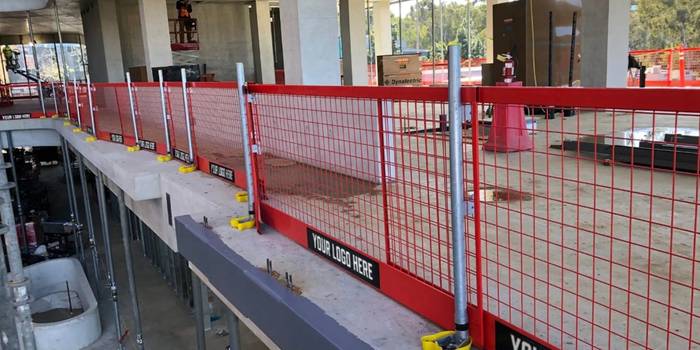
Edge protection minimum height systems need a top guardrail height of 950 mm to 1100 mm (37 to 42 inches). This height is measured above the working surface. In case of a standard permanent edge protection 1100 mm is preferred.
Edge Protection Safety Signage
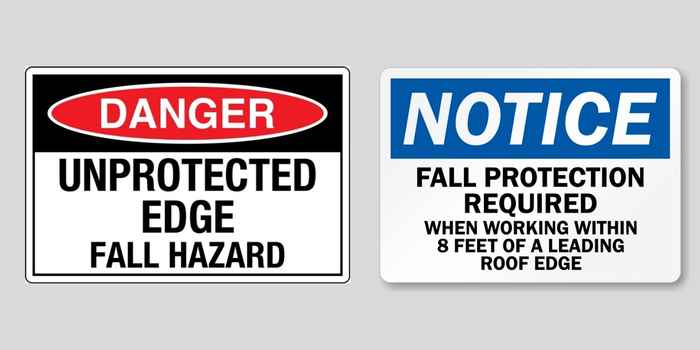
Este es un construction safety sign. This sign warns workers about unprotected edges. If you want to install these signs, they should be visible and placed near all edge protection areas. Common signs include “Caution: Edge” or “Fall Hazard”. Mostly, you see bright colors like yellow or red to attract attention.
Edge Protection System
Permanent Edge Protection
Permanent edge protection means you install such barriers that stay in place for a long time. This protection is used on rooftops, balconies, stairways, ramps and other elevated areas. These barriers protect workers from fall injuries during long term construction or maintenance.
- Fixed Guardrails o Cable Posts: These are strong rails that are attached with edges to stop falls. They provide constant protection and are ideal for balconies or rooftops.
- Collapsible Guardrail: You can fold or move these guardrails when not needed. This is a useful option when you need to go to access points.
- Freestanding Guardrail: Freestanding barriers are not fixed with floors. Basically, they stand on their own without floor fixing. Therefore, you can move them easily.
- Mesh Barriers: This is a net-like barrier. It stops tools plus workers for height falls. It can be an ideal choice for construction zones with heavy foot traffic.
- Steel Edge Protection: Heavy-duty steel barriers are preferred for long-term use. Furthermore, they are perfect for industrial sites or areas with high risks.
Temporary Edge Protection Systems
This system is installed for short-term, in case of construction, maintenance, & repair work. It is used on scaffolds, open floors, ladders and areas where permanent barriers are not yet in place. Temporary protection provides immediate safety for workers. Because these systems are easy to install, adjust, or remove as the site changes.
- Portable Guard Rails: These are lightweight rails. So, you could move them and set them up fastly. Ideal for short-term jobs.
- Net Guard Systems: These systems use strong redes de seguridad. They catch workers or materials in case of a fall. You use them in high-risk areas during active work.
- Curtain Protection Systems: It uses flexible curtain-style barriers. They cover open edges and sides. You often use them on multi-level buildings.
- Tubular Temporary Edge Protection Systems: In this system you use steel tubes and connectors. Actually, this combination creates strong guardrails for a limited time. You see them on scaffolds and slabs.
Roof Edge Protection
This protection is specifically designed to protect you at the edges of the roof. Because, during construction the edges of the roof are the most risky places. So, you can use different types of methods for this. These two techniques are most common;
- Rooftop Lifeline System: This system uses a horizontal or vertical lifeline fixed on the roof. You connect your safety harness to the lifeline. It allows you to move freely on the roof. It is suitable for large roofs where workers move a lot.
- Roof Anchor Systems: Roof anchor system is fixed with anchor points on the roof. You attach your harness to one anchor at a time. It offers limited movement compared to a lifeline. You can buy it for your small roof areas or specific work locations.
- Davit Arm System: This is a vertical mast and a horizontal arm ( like a strong crane arm fixed) that extends over the edge. You can connect your harness with it and perform your work freely. If you need to hang or suspend over an edge, a davit arm is the safest choice.
Parapet Edge Protection
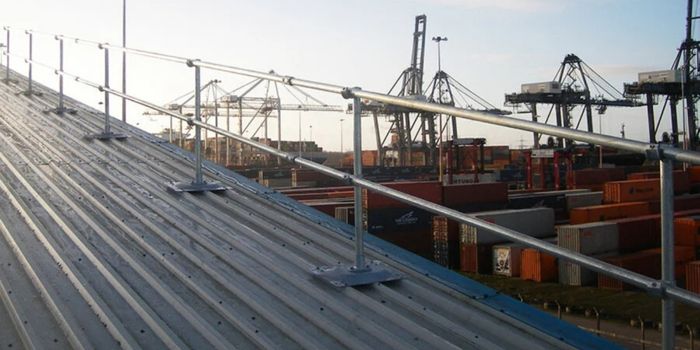
Well, parapet edge protection is built with strong and durable materials. In fact, most parapet walls use concrete due to its high strength and long life. In many buildings, brick or masonry is also used to form the parapet structure. But if you see parapets in industrial or commercial buildings, that are made up of steel panels or reinforced concrete with metal railings on top.
When the parapet height is low, additional guardrails are fixed to increase safety. You can select the material according to your need and specific site. You often see it on rooftops. But it is also used on balconies, terraces, walkways, ramps and elevated platforms. Any area with an open edge can use a parapet wall for fall protection.
Hole Edge Protection
Holes are most common on construction sites. Therefore, edge protection is used to protect these open holes on construction sites. They may appear in floors, slabs, service ducts & decks. Workers or visitors can fall in them and get injuries.
That is why hole edge protection is required wherever an open hole exists. Generally, barandillas o barreras are fixed around the edge of the hole. These systems inform people about the hazard in advance. This is the responsibility of the site safety manager to protect each hole present on the worksite.
Edge Protection Requirements
- The top guardrail of any edge protection system must be at least 950 mm above the working edge to prevent falls.
- Edge protection must include toe boards to provide extra safety and stop tools or materials from fall downs.
- The gaps between guardrails should not be more than 470 mm.
- You have to use systems that are strong enough to protect workers.
- When you have installed edge protection, then a pre-use check should be performed by an expert.
- Always remember, professional inspections should be done by a qualified person at least once every 12 months.
OSHA Edge Protection Standards
If you are installing edge protection guardrail, then you have to follow the standards of OSHA as well.
- You have to use edge fall protection for workers on surfaces 6 feet (1.8 m) or higher. Moreover, the place with an unprotected side or edge.
- OSHA-compliant guardrails must have a top rail of 42 inches (107 cm) and resist 200 lbs (890 N) of force.
- Midrails are required when there is no wall or parapet at least 21 inches high and must bear 150 lbs (667 N) of force.
Edge Protection Regulations UK
In UK, there are over 10 regulations and British standards that relate to edge protection systems. These rules cover the design, installation plus maintenance of the systems. Actually, you don’t need to know all of them if you just want to purchase a system then you have to follow one of them.
Among these standards, BS EN 13374 focuses mainly on the design of edge protection systems. It ensures that the systems can bear loads that are applied vertically or horizontally. The standard also classifies systems based on roof pitch;
- Class A for 0 to 10° (used on flat or very low-slope roofs)
- Class B for 10 to 30° (suitable for medium-slope roofs)
- Class C for 30 to 45° (best for steep roofs)
Edge Protection in Construction
What is edge protection in construction? On a construction site, you face risk at many open edges. These include roof edges, floor openings, stair voids and slab sides. You also see risk near lift shafts and balconies under construction. Workers move tools and materials near these areas every day. Without edge protection, one slip might cause a serious fall. Therefore, edge protection becomes a basic need of any construction site.
Edge Protection Scaffolding
A scaffold is a structure where you can stand and work at heights. This scaffold has open sides and edges that are exposed on scaffold levels. This is where fall risk becomes serious for you.
Now, you will see the role of edge protection. You can place guardrails on open sides of the scaffold. Mid rails sit between the top rail and platform. Toe boards are fixed at the bottom to stop tools from fall. This setup protects your workers and people below.
Edge Protection Cost
Edge Protection Products |
Approx. Cost |
| Portable or permanent guardrails | $30 to $80 per linear foot |
| Orange mesh barrier | $7 to $9 per piece |
| Safety harness | $149 to $248 |
| Davit arm system | $5000 |
| Parapet guardrail | $10 to $11 |
| Safety bollards | $18 to $25 |
Edge Protection Suppliers
If you want to buy tools or equipment for the safety of edges at your site JACKWIN is the best choice. Our company manufactures barreras de seguridad, bolardos, vallas, portable guardrails, puntales y señales de seguridad.
We have been serving the industry of road & construction safety for more than 18 years. So, you can trust us and make an order for the safety of your workers.
Para terminar
We have tried to cover almost all the aspects of edge protection. We also described the tools which are commonly used as edge protection. Always remember, you have to use the tool according to your needs. Like you can select a davit arm system when you have to maintain the edge of a building.
Preguntas frecuentes
Can Edge Protection Fit All Sites?
Basically, the traditional method of edge protection was designed specifically for that purpose. But right now the tools are made to provide multipurpose usage. So, you may use barriers, bollards, fences or any other edge protection at any site to inform about hazards.
Does Edge Protection Need To Be Certified?
Yes, you need to certify the edge protection that you have installed on the site. In fact, this certification is used to ensure the safety is according to the standards and regulations.


