

-80x69.png)
In today’s guide, we will talk about impact attenuators and why they are important for road safety. Further, you will learn their types, materials, designs and how they work to protect drivers and vehicles. We have also explained where you can install them and rules you need to follow.
What is Impact Attenuator? Crash Cushion Meaning
An impact attenuator is a safety device or physical structure used on roads to reduce the force of a crash. It protects drivers, passengers, pedestrians and slows down vehicles during collisions.
They can also guide the vehicle away from danger or workers. Impact attenuator also called crash attenuator, cowboy cushion and crash cushion.

Impact Attenuator Material
Mostly, impact attenuators are made of special materials that completely absorb energy in a crash. Their substances give the best protection for drivers, but they can be expensive. Below are common materials used to manufacture crash cushions.
- Aluminum honeycomb
- Galvanized steel
- Aluminum alloy
- Carbon fiber
- Strong plastics
- Energy absorbing foams.
Impact Attenuator Design
Impact attenuator safety devices are built in various shapes to absorb energy by deforming. These shapes include truncated cones or pyramids, cylinders, boxes and honeycomb structures.
Plus, popular designs are rectangular, trapezoidal, elliptical or cylindrical. However, you should use aluminum/steel or quality plastic in its manufacturing. Many designs now use recycled and eco friendly materials.
What is a Crash Cushion Used For?
You can use a crash attenuator to protect drivers as well as vehicles on the road. It works like a safety barrier in dangerous spots. Generally, you can see it at the ends of highways or near construction areas. Moreover, a crash cushion stops a car safely and prevents serious damage to the vehicle in case of an accident.

Impact Attenuator Types
There are several types of impact attenuators placed on roads and vehicles. They all work in different ways to protect you during an accident.
Water Filled Attenuators
Water filled attenuators use water filled plastic containers. It can absorb crash energy. You can place and move them easily, because they are not fixed to the ground. These systems generally measure 6 to 10 meters long. Further, they can protect vehicles at speeds up to 100 km/h.
However, these safety barriers do not redirect your vehicles back onto the road. Hence, they are also known as non redirective attenuators. During impact, the water moves sideways & upwards in the barrels. In such a way, it absorbs energy over time and reduces force on occupants.
Gating Impact Attenuator
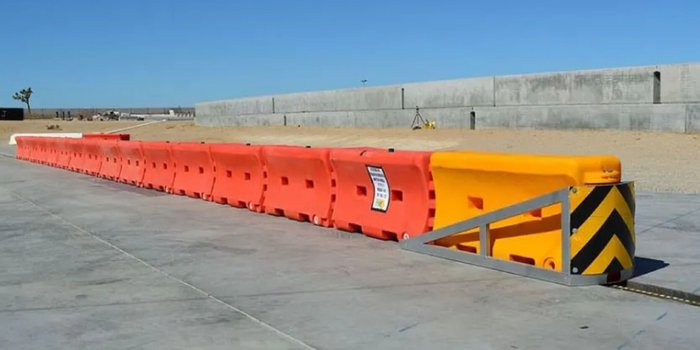
If we talk about gating attenuators, they are fixed safety systems. These structures protect point hazards. For example, they let vehicles that hit from the side pass through them like a gate.
This design absorbs impact energy over distance and reduces the risk of injury. However, gating crash cushions need enough open space around them. You should install them near bridge piers, sign supports or gore areas.
Fitch Barriers
Fitch barriers use plastic barrels which are filled with sand or gravel. That’s why they are also called sand filled plastic barrels. You can place these barrels in a triangular shape with lighter barrels in front.
So in case of a crash, the vehicle pushes through the barrels, which absorb energy and slow down your car. These systems are common at highway ramp gore areas. It is the place where a highway ramp meets the main road.

Non Gating Impact Attenuator
This is a fixed and permanent system which is placed to stop cars completely when they collide. Unlike gating types, the car does not pass through it. Energy is absorbed in controlled stages through its modular components that deform safely.
Road authorities installed these attenuators to protect wider roadside dangers such as median ends and bridge piers. These systems mostly range from 0.6 to 3 meters wide and 6 to 20 meters long.
Truck Mounted Attenuators
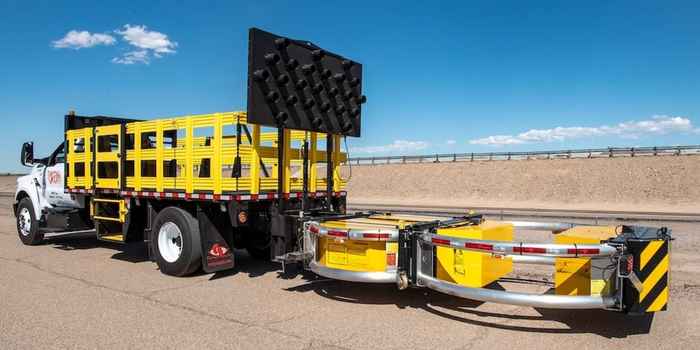
As its name shows, these attenuators are installed on vehicles/trucks that may be hit from behind. Generally, you will see them on road maintenance trucks and snow plows mainly on highways. Truck mounted attenuators (TMA) are also called impact protection vehicles (IPV) and work as a redirective barrier.
Remember, TMAs can be stationary or move slowly. In some countries including Sweden, authorities use TMA automobiles as emergency vehicles. This system has the ability to provide better protection for road workers as compared to firetrucks. Further, they cost you less to buy and repair.
Sacrificial Attenuator
A sacrificial attenuator is a general type of crash attenuator. It is made to absorb the force of a crash, explosion or shock. As a result, it gets damaged or destroyed when it works.
Unlike other attenuators which you can use again, a sacrificial attenuator is manufactured in a way that you have to replace it after one or a few impacts.
Reusable Attenuator
A reusable attenuator is also a crash cushion, which is used to protect drivers and vehicles. Well, it absorbs the force of a crash and then returns to its original shape.
That means you can use it again after a crash. Materials such as strong plastic or steel make it able to recover and reduce road repair time. Due to this property, reusable attenuators are also called self-restoring impact attenuators.
Impact Attenuator Width
In the market, impact attenuators are available in different widths based on where they are used. For example: small attenuators used for racing cars can be approx. 200 mm (8 in) wide.
However, normal road models have a standard width of 600 mm. For big hazards or fast roads, they can be more than 2.3 m (7.5 ft) wide. This size is perfect to protect objects up to 90 inches across.
How Do Impact Attenuators Work?
Crash attenuators work on the basis of kinetic energy absorption to protect vehicles and road users. Below you can read how they control cars during accidents to reduce injuries and damage.
Kinetic Energy Absorption: When a vehicle collides with a crash attenuator, the components of the attenuator system absorb the car’s moving force. This way, it makes sure the safety of the vehicle and driver.
Energy Dissipation: Inside the attenuator, you will find cushions that can be squeezed. When a vehicle hits, these cushions get compressed. As they compress, they absorb crash energy and spread it out safely. This slows the vehicle down and protects it without the cushion breakage.
Vehicle Control: The system of impact attenuator is engineered in a way that it can easily handle the car which crashes with it. After energy is taken by the system, the speed and movement of the car reduces and then stops completely.
Impact Attenuator Applications
You should install impact attenuators in areas which have maximum chances of vehicles collision with roadside hazards.
- Bridge piers and abutments
- Roadway gore areas
- Highway ramps
- Median barriers
- Work zones & construction sites
- Near roadside signs and poles
- Toll plazas
- Emergency response areas
- Tunnel entrances and exits
- Sharp curves or roadside obstacles
Impact Attenuator Regulations
In United States, impact attenuators are tested and rated according to the AASHTO MASH guidelines. You have to test these structures to see how much impact they can handle. Further, you can use highly tested attenuators in dangerous areas and high speed roads.
The MASH (Manual for Assessing Safety Hardware) and NCHRP manuals make sure the correct function of crash cushions. You should hit the attenuator by vehicles with specific speeds and angles. So you can confirm if it stops the car safely or not.
You should also place safety cones or drums around the workers & equipment in a construction zone. They guide the cars toward the Truck Mounted Attenuator (TMA). In case the car gets too close, the TMA can stop it safely.
Impact Attenuator Price
The price of an impact attenuator is not fixed. It varies on the basis of its type, size, design & brands. On average, you can buy a road safety attenuator in the range of $1200 to $3000. However, non-gating and crash cushion systems are generally expensive and may cost you roughly $20000.
Water-filled & simpler models are more affordable for you. Other factors like materials & crash rating can also increase or decrease the overall rate of impact attenuators.
Answers To Your Questions
Why Are Impact Attenuators the Future of Road Safety?
Crash attenuators are trustable for traffic safety because they can reduce up to 80% of deaths in collisions. As they use fixed objects, these devices can absorb a vehicle’s energy and slow it down easily. Modern designs are adaptable and can be installed quickly.
How Long Does an Impact Attenuator Last?
Generally, they have a life span of 5 to 7 years. After this duration, they need replacement due to material damage and small repeated impacts. Their life can be shorter if they are involved in major crashes & get damaged to protect cars.
Do Impact Attenuators Work For All Vehicle Sizes?
Crash cushions are made to protect many types and sizes of vehicles. Well, they work best when you carefully select them based on vehicle weight and speed. These systems can handle crashes of small cars and heavy trucks with the technique of material compression & momentum transfer.
Final Thoughts
So, you can see that impact attenuators are useful tools for the safety of drivers and vehicles on roads. They reduce crash damage and save lives too.
If you are looking for a professional manufacturer or supplier of impact attenuators or road safety products, JACKWIN is your best choice. You can contact us today to get high quality safety solutions for your project.


