

-80x69.png)
Baseball is a bat and ball game which is played between two teams. There are nine players in each team. Moreover, it has nine innings with alternate batting and fielding.
To make this game fair and safe, you must know about baseball field dimensions. In this guide, we have written all MLB baseball field length & sizes for baseball ground including youth leagues and professional games.
Baseball Field Size
Major league baseball (MLB) decides the standard dimensions of the baseball ground. You have to follow MLB official guidelines to keep the game fair and safe.
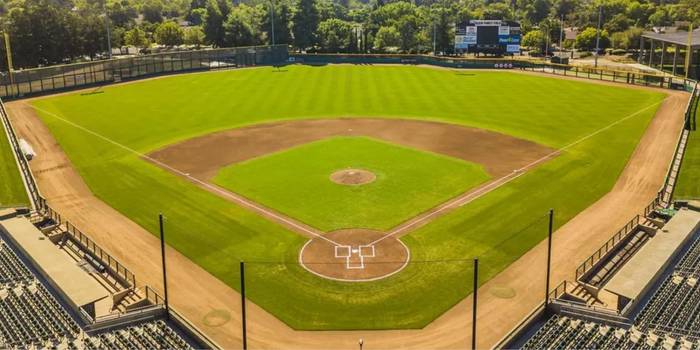
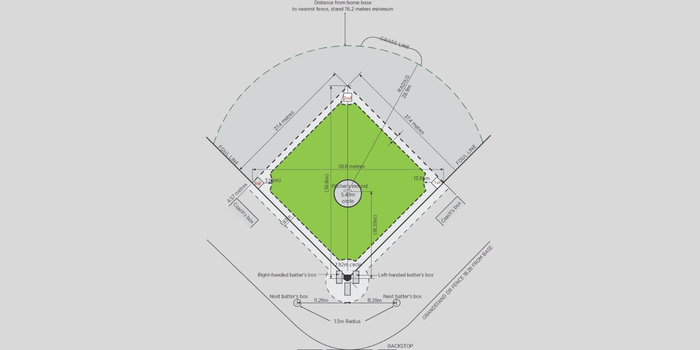
Baseball Field Size in Meters
A standard baseball field has a 27.43 meters gap between each base. You can place the pitcher 18.44 meters from home plate. The outfield fence around 91 to 122 meters away from home plate.
Baseball Field Dimensions in Feet
In a standard adult baseball field, you have to design each base 90 feet apart. You will see the pitcher’s mound is 60 feet 6 inches from home plate. The outfield fence is 300 to 400+ feet from home plate.
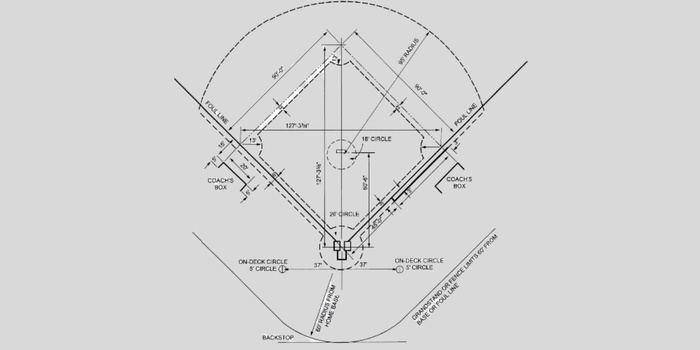
Baseball Infield Dimensions
The infield is the square zone at the center of the baseball ground. It has four bases such as home plate, first, second and third. These all arranged in a diamond shape. You use this section to play most of the action, hitting, running and fielding. Below you can see baseball ground marking and infield sizes.
Diamond Zone
The baseball diamond shape area is a square with 90 feet (27 meters) on each side. You can measure this distance between two bases. This is the main section of the baseball field. When you hit the ball, you have to run around the bases of this area and can stop at any base.
Coaches’ Box
There are two coach boxes in a baseball game. You will first box near first base and second box near third base. These rectangles have dimensions of 20 ft by 10 feet. Generally, batting team coaches stand inside the boxes. They assist base runners and provide them equipment such as protective gear & sliding gloves.
On Deck Circle
The on deck circle is located in foul territory which is part of the infield area. This circle is 5 feet in diameter. Basically, the on deck batter (next batter) uses this zone to warm up and get ready safely before their turn at bat.
Pitcher’s Mound:
The pitcher’s mound is a raised & circular area in the middle of the infield. A player stands in this zone to throw the ball. It is higher than the rest of the field. The pitcher mound is 60 feet 6 inches (18.4 meters) from home plate.
Базовые показатели
Baselines are straight markings which paint to connect the bases on the diamond. In professional fields, these lines are 90 feet or 27.4 meters long. However, you will find some baselines not painted on the field. These include lines between first & second base and second and third base.
Running Lane
This lane is a special path which you will see near first base. It has a width of 3 feet. You need to mark the running lane with a 45 foot line next to the foul line and first base. Basically, this path helps you to move safely between home plate and first base. You have to stay inside or on the lines of this lane.
Baseball Field Bases
Each base has a size of 18 inch square at the corners of the diamond. Later, they were made bigger around 15 inches in September 2022. The main goal is to keep players safe and reduce collision risks between batters and basemen.
Home Plate
The home plate is actually the base which is designed to complete the diamond. To score a run, you must run around all the bases and then reach home plate. Well, home plate is 90 feet (27.4 meters) from first base on the right and third base on the left. It has a distance of 127 feet 3 inches (38.8 meters) from second base. This way, these bases create a 90 degree angle at home plate.
Batter’s Box
The batter’s box is the area where you (as a batter) should stand to hit the ball. You will find this zone around the home plate. There are two rectangular boxes. Each box is 7 ft (2.1 m) long and 3 feet (0.9 m) wide. Right handed batters can use the box on the left. If you are a left handed batter, you should use the box on the right.
Catcher’s Box
You will notice this zone behind home plate. The baseball ground had two catcher’s boxes. The first box is present near first base and second one close to third base. In professional baseball, the catcher’s box is 43 inches wide and 8 feet long.
Pitching Rubber
The pitching rubber is also known as pitcher’s plate. In baseball ground, it is a white rectangle which is 24 inches long and 6 inches wide. You will find this part at the top of the pitcher’s mound. As a pitcher, you have to touch it with your foot to start your pitch.
Baseball Outfield Dimensions
The baseball outfield is the grassy area which you will see beyond the infield. You can play in the outfield location when a batter hits the ball far from the bases.
Foul Lines in Baseball
These are two straight lines marked across the back of home plate and left/right field foul poles. They indicate the boundary between fair and foul territory. They must be at least 320 ft (97.5 m) long on both sides of the field.
Baseball Center Field Depth
If we talk about center field, it is the deepest part of the outfield. You can measure it across home plate straight to the center field fence. On most adult fields, the center field depth is approximately 400 feet (122 meters). However, some fields can be a bit shorter or longer.
Outfield Wall/Fence
The outfield fence is used to mark the edge of the playground. You can see it at the end of the outfield. The distance between home plate to the fence mostly ranges 300 to 400+ feet (91 to 122 meters). When you hit the ball over this fence in fair territory, you can score a home run.
Baseball Field Layouts By Leagues
Below we listed all NCAA baseball field dimensions and ground sizes for different leagues.
Major League Baseball Field Dimensions
Major League Baseball always follows official infield and outfield measurements for all professional games.
| Baseball Ground Area | Field Size (ft) | Size in meters |
| Mound height | 10 in | 0.254 m |
| Base size | 18 × 18 in | 0.457 × 0.457 m |
| Pitching distance | 60 ft 6 in | 18.44 m |
| Distance between bases | 90 ft | 27.43 m |
| Infield radius | 95 ft | 28.96 m |
| Home plate to second base | 127 ft 3⅜ inches | 38.79 m |
| Mound diameter | 18 ft | 5.49 m |
| Minimum left/right field fence | 325 ft | 99.06 m |
| Minimum center field fence | 400 ft | 121.92 m |
Baseball Field Dimensions High School
For high school baseball, you need to follow standard field rules. However, these grounds are slightly smaller as compared to professional fields. Another point to note is that college baseball field dimensions are the same as high school baseball ground size.
| High School/College Baseball Field | Measurements in feet | Measurements in meter |
| Base distance/baselines | 90 feet | 27.43 m |
| Outfield fence | 295 to 393 ft | 90 to 120 m |
| Pitch distance | 60 feet | 18.44 m |
| Land requirement | 150,694 to 183,002 ft² | Around 14000 to 17000 m² |
| Home to second | 127 feet | 38.7096 m |
Middle School Baseball Field Dimensions
For middle school baseball fields, you generally need to follow the Национальная федерация ассоциаций государственных средних школ (NFHS) rules for layout.
| Оценка | Diamond Size (Base to Base) | Pitching Distance | Outfield Fence Distance |
| 7th | 70 ft × 70 ft | 50 футов | Approx. 200 ft |
| 8th | 80 ft × 80 feet | 54 ft | Around 300 feet |
| 9th+ | Full size (90 ft × 90 ft) | 60 ft 6 in | 300 to 400 ft |
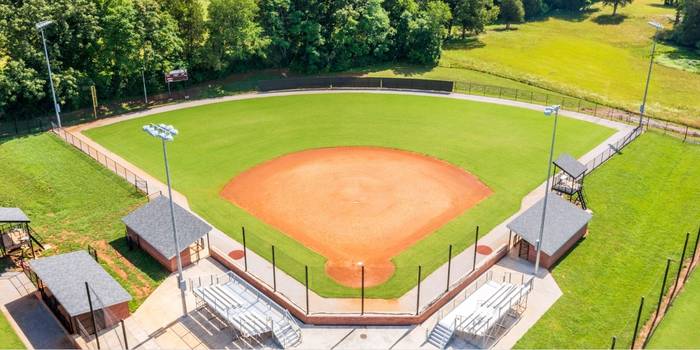
Little League Baseball Field Dimensions
Little League Baseball is an organization that is responsible for local youth baseball leagues in the United States as well as around the world. It has different age groups. Little league fields or youth baseball field dimensions are smaller than MLB fields. That means, you have to use short base paths so young players can hit & run safely.
| Youth League Division | Возрастная группа | Centerfield | Left/Right Field | Базовое расстояние | Pitching Distance |
| Minor League | 5 to 12 | Over 200 ft | 200+ ft | 60 ft (can be 50 ft) | 46 feet |
| Intermediate 50/70 | Between 11 and 13 | More than 200 ft | 200+ ft | 90 ft or 70 ft | 60 ft 6 in or can be 50 ft |
| Junior League | 12 to 14 | 300+ ft | More than 300 ft | 90 ft or 75 ft | 60 ft 6 in or 54 ft |
| Tee Ball | 4 to 7 | 200+ ft | Over 125 ft | 50 футов | Not used |
| Senior League | 13-16 | 300+ feet | 300 ft or greater | 90 feet | 60 feet 6 in |
| Major League | 9 to 12 | 200+ feet | 200+ ft | 60 ft (may be 50 ft) | 46 ft |
Bronco Baseball Field Dimensions
Following are the dimensions for bronco baseball stadium.
| Bromco Baseball Ground Measurement | Standard Distance |
| Base paths (home to second) | 99 ft |
| Pitching distance | 50 футов |
| Centre field size | More than 275 feet |
| Базовые показатели | 70 feet |
| Outfield fence | 275+ ft to center and 225 feet along foul lines |
Baseball Field Sizes By Age
Pinto Baseball Field Dimensions: Under 5 To 8
Pinto baseball is for younger players aged around 5 to 8. You should design smaller fields so kids can play without any risk.
| Field Measurement | Distance |
| Base paths (Home to Second) | 70 ft 8 in |
| Базовые показатели | 50 футов |
| Pitching distance | 38 feet |
| Outfield fence | 200+ ft to center and 125 ft along foul lines |
8U Baseball Field Dimensions
8U baseball is perfect for players around 7 to 8 years old. To design these grounds, you have to use shorter base paths and a closer pitching distance.
| Under 8 Player Baseball Field | Measurement |
| Base paths | 60 ft (18.29 m) |
| Pitching distance | 40 feet (12.19 m) |
| Outfield fence | 150 to 180 ft (45.7 to 54.9 m) |
9U Baseball Field Dimensions
This field is a bit bigger as compared to younger divisions. As a result, it gives you more space to run, throw or hit the ball.
| Ground Features | Under 9 Players Baseball Field Size |
| Pitching distance | 6 feet or 14.02 m |
| Base paths | 60 ft or 18.29 meters |
| Outfield fence | 180 to 200 ft (54.9-61 m) |
10U Baseball Field Dimensions
10U baseball is made for players around 9 to 10 years old. At this level, the field gets bigger, which helps players to get ready for higher divisions such as Bronco or 12U play.
| Under 10 Players Stadium Features | Field Measurement |
| Base paths | 60 ft (18.29 m) |
| Pitching distance | 46 ft (14.02 m) |
| Outfield fence | 180–200 ft (54.9–61 m) |
12U Baseball Field Dimensions
These youth baseball field dimensions are useful for you to transition safely toward full size fields and improve your fielding skills.
| Baseball Ground Parts | Размеры |
| Base paths | 70 ft (21.34 m) |
| Pitching distance | 50 ft (15.24 m) |
| Outfield fence | 200–225 ft (61-68.6 m) |
13U Baseball Field Dimensions
These are also called PONY league baseball field dimensions. This table will show you the baseball field size for players under 13 or 14 years.
| Field Parts | Стандартный размер |
| Base paths | 90 ft (27.43 m) |
| Pitching distance | 60 ft 6 in (18.44 m) |
| Outfield fence | 300+ ft (91.4+ m) |
How To Line a Baseball Field?
Baseball field markings are the lines and shapes that you paint on a baseball field. These lines show where players should stand and play.
- You need to measure the distances for bases and pitching mound. For that purpose, you can use measuring tape.
- Then, you can use chalk, lime or a baseball field marking paint to draw visible lines.
- You have to make sure foul lines, base paths plus boxes are straight and clear.
- Now, you can place the pitcher’s rubber accurately at the correct distance from home plate.
- After that, you should confirm that the outfield boundaries are visible and consistent.
- For more accurate ground marking, you should use a baseball field striping machine (field marking machine).
Люди также спрашивают
How Big is the Warning Track on a Baseball Field?
A baseball warning track is generally 10 to 15 feet (3 to 4.5 meters) wide in high school and college fields. In major league baseball games, it has a width of 15 to 16 feet.
Where is Baseball Primarily Played?
Baseball is mainly played and followed in North America (United States, Canada, Mexico), the Caribbean (Dominican Republic & Puerto Rico) and parts of East Asia (Japan, South Korea, Taiwan etc).
How Large is the Baseball Infield Dirt Area?
A professional or high school baseball infield usually covers approximately 11,200 to 18,300 square feet. Well, its size depends on the type of field such as hybrid turf/dirt infield or fully all dirt.
Are NCAA Baseball Field Dimensions the Same As MLB?
NCAA baseball field dimensions are mostly similar to MLB fields. The main difference is the outfield fence, which can vary more in college stadiums. NCAA fields have smaller or variable outfield distances due to space limits.
Заключение
To master the game or plan a baseball ground, knowledge of the exact dimensions of a baseball field is necessary. With proper base paths and outfield layouts, you can make sure game fairness and better strategies for players of all levels.
If you are looking for line marking paint suppliers for your project, ДЖЕКВИН is your perfect partner. You can also order a роботизированная маркировочная машина and tapes from us. Поговорите с нашей командой and get marking products at affordable prices.
Смотрите также:
Каков размер футбольного поля?


