


Main priority of every road authority and transportation agency is to protect people and reduce the severity of crashes. It is the reason you see different metal crash barriers along busy roads. Their two common types are Thrie beam and W beam guardrails.
Both have similar basic purpose, but their design and performance are not same. Therefore, you should make the right decision for the overall success of your road safety project. We created today’s article to compare Thrie beam and W beam crash barrier.
What is a Thrie Beam Guardrail?
Thrie beam guardrail is a three wave steel barrier used to protect vehicles from roadside dangers. This extra bend in its beam makes it more rigid. Hence, you will have greater protection during a vehicle crash. It also connects to strong steel posts.

If a vehicle collides with this traffic barrier, the beam will redirect the vehicle back toward the road. You can install this barrier along bridges, high speed roads, sharp curves and complex road sections where you need maximum protection.
What is a W Beam Crash Barrier?
A W beam barrier is a two-wave metal roadside crash barrier used to absorb and redirect the force of a vehicle during a crash. It is one of the most common guardrail designs. You will find its steel beam looks exactly like the letter “W”.
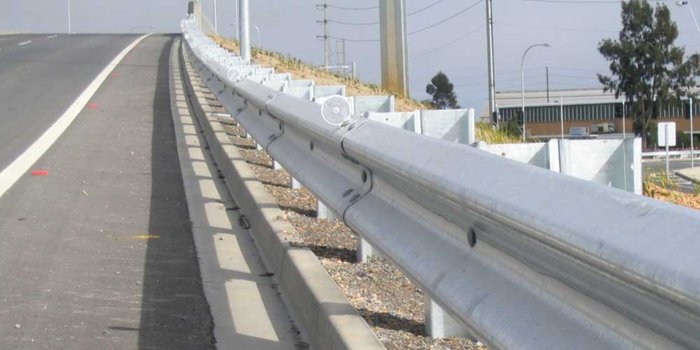
In case a car hits the guardrail, the beam will bend and absorb some of the crash energy. You can see W-beam guardrails on highways, rural roads, bridges and roads in residential areas.
Difference of W Beam vs Thrie Beam
| Thrie Beam | W Beam |
| Three wave design with a taller and deeper profile | Two wave design with a W-shaped profile |
| Offer higher strength and rigidity | Less rigid and can bend more during a crash |
| Perfect for higher impact crashes and heavier vehicles | Suitable for lighter and moderate impact crashes |
| Around 31 inches high | Two wave guardrail is 27 inches tall |
| Minimize roadside crash severity around 50% to 60%. | Can reduce roadside crash severity by 40% to 50% |
| Needs less maintenance but damaged parts still need inspection and replacement | Easier to repair and generally costs less to maintain |
| Have service life of 25 to 30 years or more with proper care | Can last around 20 to 30 years with proper maintenance |
| Costs around $30 per linear foot | Estimated rate is $25 per linear foot |
| Ideal for high risk areas, heavy vehicles and locations that need stronger protection | Best for standard roadside protection and common road applications |
Design and Structure
A three wave barrier is a heavy duty highway safety barrier with three wave shaped bends. This design gives the beam more height and strength. Therefore, it can easily handle stronger impacts. Further, you can secure the rail of this barrier to steel posts with bolts and spacers.
On the other hand, w beam has a simple two bend design. You will find its profile similar to the letter “W”. Due to its simple construction, this is an affordable and widely used guardrail. Its shape also gives the barrier enough flexibility to bend and redirect a vehicle. It is also known as a double or two wave barrier.
Strength & Durability
Thrie beam guardrails made of high strength structural steel with a hot-dip galvanized zinc coating. It protects the steel from rust and corrosion. Plus, they can handle extreme impact forces.
For example: H2-rated thrie barrier can stop a vehicle which is 10000 kg (22000 lbs.) heavy and collide with a beam at speeds of around 90 km/h (56 mph). This load bearing capacity makes it suitable for high speed highways and areas where chances of severe crashes are high.
W beam guardrails also use corrugated steel sheets and are resistant to rust or corrosion. But if we talk about the strength of them, you will mostly find it less rigid than the triple wave barrier. That’s why it can bend more during a crash. Although you will still get good strength and protection, it offers less protection in high speed or high impact crashes.
Dimensions and Parameters
Dimensions of a guardrail affect its strength and overall performance. Triple wave guardrail and W beam crash barrier is available in different sizes and thicknesses. This table compares their main features and sizes.
| Specifications | Thrie Beam Dimensions | W Beam Dimensions |
| Height | 31 inches | 27 inches |
| Weight | 12 to 16 kg per meter | 7 to 10 kg per meter |
| Thickness of material | 10 gauge | 12 gauge |
| Deflection distance | 36 inches | 42 inches |
| Energy absorption | High impact level (around 8000 joules) | Moderate impact (up to 6000 joules |
| Tested Impact absorption | Tested for impacts at 100 km/h | Crash tested at 80 km/h |
Effectiveness
Thrie beam barriers are more effective than double wave barriers. This is because of its three wave shape which gives it greater beam depth and stiffness. According to the Federal Highway Administration (FHWA), if you install three wave guardrails properly, it can reduce crash severity by 50% to 60%.
If we talk about the effectiveness of two wave guard rail, it is comparatively less strong due to its lightweight and flexible design. These rails minimize roadside crash severity 40% to 50%. Reports also show a 30% reduction in fatal crashes after the installation of W shaped barriers.
- Study on W beam models effectiveness: The MGS (improved W-beam highway guardrail system) performed well at a 5:1 flare rate. During this research, the basic G4(1S) W-beam could not meet the crash criteria at flare rates steeper than 15:1.
Life Span & Maintenance
A thrie beam guardrail can last for 25 to 30 years or more. They can stay in good condition for a long time if you maintain it well and protect it from heavy corrosion. These structures are better able to handle harsh conditions. Although it needs less frequent maintenance, you should check the beam, posts, bolts and connections after a crash. Never forget to inspect the system and replace any bent/damaged parts.
In contrast, W Beam guardrail can also last around 20 to 30 years with proper care. But it cannot handle extreme collision force. Due to its simple design, it will be easy to maintain this barrier. Suppose they develop corrosion over time, then you can generally repair it more easily and at a lower cost. With regular maintenance, a W-beam can also provide a long service life.
Cost
As we told you, Thrie beam has a stronger and more complex design. This is why it also costs you more to manufacture and install. The average price of a triple wave barrier is approximately $30 per linear foot. Its placement can also take more time. The reason is that workers need to handle and position the heavier barrier carefully.
In terms of W beam cost, it is an affordable option as compared to thrie beam guardrail. In fact, you need less budget for its manufacturing and installation. The estimated cost of double wave guard rail is around 25 US dollars per linear foot. Not only this, its simple design also makes installation faster and requires less labor.
Applications
You can use thrie beam crash guardrails where you need stronger roadside protection. For example: they work well on highways, bridges, medians, tunnels, construction zones, steep slopes and areas with large roadside hazards. Their taller and stronger profile makes them your good choice for locations where you want to handle higher impact crashes or larger vehicles
You can also purchase W-beam guardrails for many common roadside safety needs. Ideally, you should install them on highways, rural roads, curves, bridges, medians and roadsides near fixed hazards. Due to their simple design, road authorities mostly prefer them for standard roadside protection where the risk of severe accidents is not high.
Pros & Cons of Thrie Beam Guardrail
| Positive Aspects | Negative Points |
| Higher strength due to its three wave design | Costs more because they use more material and require specialized components |
| Deeper profile provides better control for larger and heavier vehicles in suitable tested systems | Larger beam uses more steel, which make it hard to handle and transport |
| Its stronger profile can reduce barrier deflection during a crash | Some designs need more installation space |
| Most versions meet demanding crash-test requirements (MASH TL-3 and older TL-4 systems) |
Benefits & Limitations of W Beam Guardrail
| Advantages | Disadvantages |
| W shaped barrier costs less than stronger and heavier guardrail systems | Its two wave profile provides less stiffness |
| Simple design makes installation and replacement easier | Beam can move farther during a crash |
| Beam can bend and absorb crash energy during an impact | Severe impact can bend the beam, posts or connections |
| You can replace damaged beam sections, posts & hardware, so you do not need to change the whole system in case of damage |
Thrie Beam / W Beam Guardrail Manufacturers
Are you a road contractor or traffic safety distributor and you want to buy strong crash guardrails for your projects? If yes, then you need a manufacturer who can supply strong and reliable products in the quantity you require.
JACKWIN is a professional manufacturer and supplier of premium quality guardrails & safety barriers. We also offer OEM and ODM services for our customers around the world.
You can get customized Thrie beam or W beam barriers. This is a big advantage for you if you want to adjust product designs, sizes, colors and other specifications according to your requirements. You can contact us anytime and our team will guide you in choosing the right guardrail.
Frequently Asked Questions
When Do Countries Prefer Thrie Beam?
Many countries and transportation agencies prefer thrie beam (triple wave) over W shaped beam for high risk and high speed roads. They work well on roads with many heavy trucks, buses or commercial vehicles.
Can a W Beam Guardrail Stop a Truck?
A W-beam guardrail has the ability to redirect vehicles such as heavier pickup trucks and small utility trucks. However, a standard two wave beam system can not provide enough control for heavy commercial trucks, tractor-trailers and large semi trucks.
Is it Cheap To Retrofit W Beam to Thrie Beam?
Yes, the upgradation of a w beam to Thrie beam can cost you less than placement of a new three wave beam section. With this approach, you can also reuse existing steel posts and foundations. In fact, you will save 40% to 60% compared with a new triple wave barrier installation.
How Can You Tell if a Guardrail is NCHRP-350 or MASH Rated?
To confirm if guardrail is NCHRP-350 or MASH rated, you should inspect its rail height, posts, blockouts, manufacturer markings and project documents. These details will be helpful for you to identify which crash test standard the guardrail meets.
Wrapping It Up
So, Thrie beam or W beam? The right choice totally depends on your road safety project requirements. You should prefer triple wave guardrail if you want high strength, better vehicle control and protection for high risk areas. But if you are looking for standard roadside protection and a more budget friendly option, our recommendation for you is a two wave W crash barrier.
Always consider vehicle size, crash risk, road conditions, installation space and required safety standards before you make your final choice. If you have further inquiries related to this topic, you can send us a message.


